
If you are paying off several debts at once, you have probably heard of two popular strategies: the debt snowball and the debt avalanche. Both work. Both are better than paying a little on everything and hoping. But they put your extra money in different places, and that changes how fast you finish, how much interest you pay, and how motivated you feel along the way.
This guide compares the two methods on the same set of debts, with the same monthly budget, so you can see the real difference in months and dollars. You can model your own balances with a debt consolidation calculator and compare strategies side by side.
Quick Answer: Snowball or Avalanche?
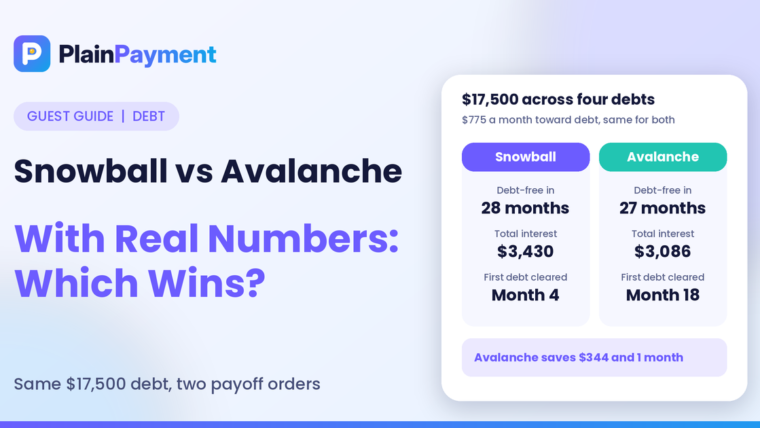
The avalanche usually costs less. The snowball often feels better. In the example below, with $17,500 of debt and $775 a month to pay it, the avalanche finished one month sooner and saved $344 in interest. The snowball cleared its first debt in month 4, while the avalanche cleared its first debt in month 18.
If your highest-rate debts are also your largest, the gap can be bigger. If your debts are small and the motivation matters, the snowball can keep you going. The best strategy is the one you will actually follow to the end.
How Each Method Works
Both strategies share the same base:
- Make the minimum payment on every debt.
- Put all extra money toward one target debt.
- When that debt is paid off, add its payment to the next target.
The only difference is how you choose the target.
| Method | Which debt gets the extra money first | Main benefit |
|---|---|---|
| Snowball | The smallest balance | Quick wins and motivation |
| Avalanche | The highest interest rate | Lowest total interest |
The word “rolling” matters. When a debt disappears, its payment does not go back into your budget. It rolls into the next debt, so your payments grow as you go.
The Example Used in This Guide
All numbers are illustrations, not offers. Your debts will differ.
| Debt | Balance | APR | Minimum payment |
|---|---|---|---|
| Card A | $2,000 | 17% | $60 |
| Card B | $5,500 | 26% | $140 |
| Card C | $1,000 | 15% | $35 |
| Personal loan | $9,000 | 10% | $290 |
| Total | $17,500 | $525 |
- Total monthly budget for debt: $775, which means $250 in extra money on top of the minimums
- No new charges on any card
- Interest is added monthly, and payments are made at the end of each month
The Two Payoff Orders
| Order | Snowball (smallest balance first) | Avalanche (highest rate first) |
|---|---|---|
| 1 | Card C ($1,000) | Card B (26%) |
| 2 | Card A ($2,000) | Card A (17%) |
| 3 | Card B ($5,500) | Card C (15%) |
| 4 | Personal loan ($9,000) | Personal loan (10%) |
Notice that the two lists are very different. The snowball goes after the smallest debt first, even though it carries a lower rate. The avalanche goes after Card B first, even though it is the second largest balance, because it charges 26%.
The Results
| Measure | Snowball | Avalanche |
|---|---|---|
| Months to be debt-free | 28 | 27 |
| Total interest paid | $3,430 | $3,086 |
| Total paid | $20,930 | $20,586 |
| First debt paid off | Month 4 | Month 18 |
| Difference | Saves $344 and 1 month |
Here is when each debt is cleared:
| Debt | Snowball payoff month | Avalanche payoff month |
|---|---|---|
| Card C | 4 | 22 |
| Card A | 10 | 21 |
| Card B | 22 | 18 |
| Personal loan | 28 | 27 |
The snowball clears two debts by month 10. The avalanche clears none until month 18, and then it finishes three debts within five months, from month 18 to month 22. That late rush is why many people find the avalanche harder to stick with, even though it ends up cheaper.
How the Balance Falls Over Time
This table shows the total remaining balance under each method:
| Month | Snowball balance | Avalanche balance | Avalanche is ahead by |
|---|---|---|---|
| 6 | $14,166 | $14,131 | $35 |
| 12 | $10,579 | $10,431 | $148 |
| 18 | $6,639 | $6,363 | $276 |
| 24 | $2,292 | $1,956 | $336 |
| 30 | $0 | $0 | $0 |
The gap is small at first and grows as the high-rate debt disappears. By month 24, the avalanche borrower owes about $336 less.
What If You Only Paid the Minimums?
To see the value of either strategy, compare it with doing nothing extra. If each debt were paid at its minimum with no rolling, the results would be:
| Debt | Months to pay off | Interest |
|---|---|---|
| Card A | 46 | $726 |
| Card B | 89 | $6,943 |
| Card C | 36 | $245 |
| Personal loan | 37 | $1,457 |
| Total | 89 months for the last debt | $9,371 |
With minimums only, you would be paying for about 7.4 years and about $9,371 in interest. Either strategy cuts the time to about 2.3 years and the interest to between $3,086 and $3,430, saving more than $5,900. That is the real prize. The choice between the two methods is worth a few hundred dollars. The choice to use a method is worth thousands.
How the Gap Changes With Your Budget
The size of the avalanche advantage depends on how much you can pay each month:
| Monthly debt budget | Snowball: months and interest | Avalanche: months and interest | Avalanche saves |
|---|---|---|---|
| $650 | 35 months, $4,630 | 34 months, $4,192 | $438 |
| $775 | 28 months, $3,430 | 27 months, $3,086 | $344 |
| $900 | 23 months, $2,759 | 23 months, $2,487 | $271 |
| $1,050 | 19 months, $2,251 | 19 months, $2,039 | $212 |
Two lessons stand out:
- A bigger budget shrinks the gap. The more you pay, the less the order matters, because every debt is paid off sooner.
- A tighter budget grows the gap. If money is limited, the high-rate debt is more costly to leave alone.
In every case, paying more per month matters more than which method you choose.
When the Two Methods Give the Same Result
If your smallest debt also has the highest rate, the two methods use the same order, and the result is identical. This happens in some households, especially when small store cards carry high rates.
Differences are biggest when a large balance has a very high rate, as with Card B in the example, or when a small balance has a low rate, as with Card C.
When the Snowball May Be the Better Choice
Pick the snowball if:
- Motivation is your biggest risk. Early wins keep many people on track.
- You have several small debts. Clearing them reduces the number of bills and the mental load.
- You have tried before and stopped. A fast first win can rebuild confidence.
- The interest difference is small. If rates are similar, you give up little.
When the Avalanche May Be the Better Choice
Pick the avalanche if:
- You want the lowest total cost. It saves the most interest.
- One debt carries a very high rate. Paying it first removes the biggest cost.
- You are disciplined with numbers. You can wait for a longer first payoff.
- The rate gap between debts is large. A bigger gap means bigger savings.
An APR calculator can help you check the true cost of each debt, including fees, so you can rank them accurately.
A Hybrid Approach
You are not locked into one method. A few practical blends:
- Quick win, then avalanche. Pay off the smallest debt first for a fast win, then switch to highest-rate order.
- Avalanche with a cap. Use the avalanche order, but if two debts have similar rates, pay the smaller one first.
- Split the extra. Put most extra money on the high-rate debt, and a small amount on the smallest debt to get a quick win.
- Handle a special case first. If a debt has a very high penalty rate or is close to going to collections, deal with it before anything else.
Any plan that keeps you paying beats a perfect plan you abandon.
Other Ways to Speed Things Up
Both methods work better with a few helpers:
- Lower your rates. Ask issuers for a reduction, or look at a 0% balance transfer or a lower-rate loan after checking fees.
- Free up extra money. Cut expenses, sell items, or add income. Every extra $50 shortens the timeline.
- Use windfalls. A tax refund or bonus can wipe out a small debt at once.
- Automate payments. Automatic payments protect you from late fees.
- Stop adding new debt. Pause new card charges while you pay down the old balances.
- Keep your credit healthy. Paying cards down lowers utilization. A credit utilization calculator shows how your balances compare with your limits.
Protect the Plan With a Cushion
A debt plan fails when a surprise expense goes back on a card. Build a small emergency fund while you pay down debt. An emergency fund calculator can help you set a target, and even a starter fund of $1,000 can prevent new charges. If you can, finish your starter fund before you push hard on extra debt payments.
A Step-by-Step Way to Start
- List every debt. Write down the balance, APR, and minimum payment.
- Find your total monthly budget for debt. Include the minimums and any extra you can add.
- Choose snowball, avalanche, or a hybrid. Decide which fits your temperament.
- Rank the debts in your chosen order.
- Pay minimums on everything and the extra on the target.
- Automate every payment.
- When a debt is paid, roll its payment into the next one.
- Track progress monthly. A simple chart helps.
- Use a calculator to model your plan. A loan payoff calculator shows how added payments shorten each debt.
- Celebrate milestones without new spending. A free reward keeps you motivated.
Common Mistakes to Avoid
- Not rolling payments forward. When a debt is paid off, send its payment to the next one.
- Skipping the minimums. Late payments bring fees and credit damage.
- Adding new debt. New charges cancel your progress.
- Ignoring fees and promotional rates. A 0% promotion that ends can change the order.
- Spreading extra money across every debt. Focus it on one target.
- Quitting after a slow stretch. The avalanche in particular can feel quiet at first.
- Comparing only the balance. The rate matters.
- Forgetting an emergency fund. Without one, debt returns.
Quick Checklist
- List every debt with its balance, rate, and minimum.
- Decide on a monthly amount you can keep paying.
- Choose snowball, avalanche, or a hybrid.
- Pay minimums on everything and extra on one target.
- Roll payments forward as debts are paid.
- Automate payments to avoid late fees.
- Stop adding new debt.
- Build a small emergency fund.
Bottom Line
The avalanche costs less, and the snowball often feels better. In the example, the avalanche saved $344 and one month compared with the snowball, but the snowball delivered its first win in month 4 instead of month 18. Both beat minimum payments by more than $5,900.
Choose the method you will stick with, pay as much as you can each month, and roll every freed-up payment forward. These examples are for education and are not financial advice. A nonprofit credit counselor or licensed financial professional can review your debts and help you build a plan.
FAQs
Which is better, debt snowball or debt avalanche?
The avalanche usually saves more money, because it pays off the highest-rate debt first. The snowball often builds momentum, because it clears the smallest debt first. In this guide’s example, the avalanche saved $344, but the best method is the one you will follow to the end.
How much interest does the avalanche save compared with the snowball?
It depends on your balances, rates, and budget. In the example, it saved $344 and one month at a $775 monthly budget. The gap was larger with a smaller budget and smaller with a larger one.
Does the order of payoff matter if my budget is large?
Less than you might think. With a bigger monthly budget, every debt is paid off sooner, so the difference between methods shrinks. In the example, the gap fell from $438 at $650 a month to $212 at $1,050 a month.
Can I switch methods partway through?
Yes. Many people start with the snowball for a quick win and switch to the avalanche. Keep paying all minimums, and keep rolling freed-up payments forward.
Should I use a balance transfer or consolidation loan with these methods?
It can help, if it lowers your rate and you avoid adding new debt. Compare fees and the total cost first. A lower rate shortens the payoff for either method.
What if my smallest debt also has the highest interest rate?
Then both methods use the same order, and the result is the same. The methods differ when small balances have low rates or large balances have high rates.
Should I build an emergency fund before paying extra on debt?
Many people build a small starter fund first, make all minimum payments, and then put extra money toward debt. A cushion keeps surprise bills from going back on a card and ruining your progress.