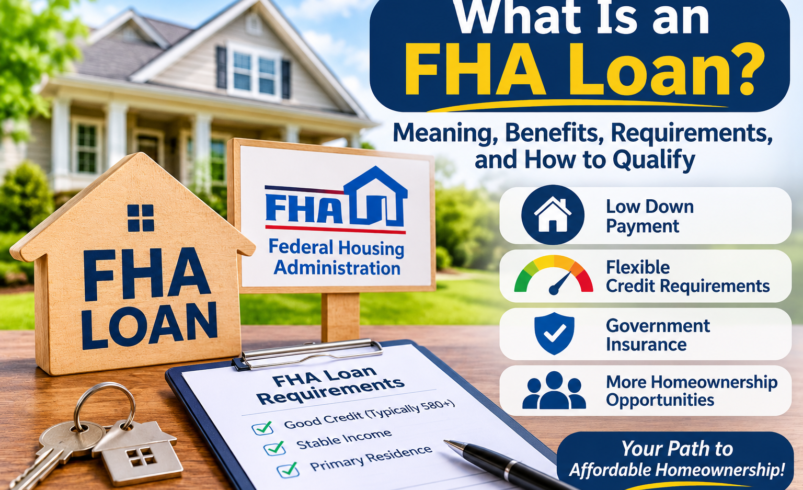

Purchasing a home is a major financial move, but it can also be challenging to qualify for a traditional home loan, particularly if you have a lower credit rating or don’t have enough savings. An FHA loan can help in this case. If you are curious as to what is a FHA loan, it is federally insured by the Federal Housing Administration (FHA), which falls under the jurisdiction of the U.S. Department of Housing and Urban Development (HUD).
The FHA does not offer the borrower any funds. Rather, it covers loans granted by the approved lenders and lowers their economic danger in case the borrowers fail to pay their mortgages. This protection helps to ensure that lenders are willing to make more flexible qualification requirements.
If you have limited credit history or are a first-time home buyer, it’s important to be familiar with what a FHA mortgage is so you can consider other financing options. One of the advantages of an FHA home loan mortgage is that it may offer less stringent credit requirements and lower down payment options than some of the conventional mortgages.
What Is an FHA Loan and How Does It Work?
First, it is crucial to understand what FHA stands for if you want to learn what is the FHA. FHA is short for Federal Housing Administration, an agency set up to promote affordable housing and expand mortgage lending options.
FHA meaning is directly related to mortgage insurance. FHA loan borrowers do not borrow from the government, but work with approved FHA lenders instead. These FHA bank lenders accept and process applications, approve applicants who qualify, and fund the mortgage.
The most significant benefit to taking an FHA loan is its allowance for flexible down payment amounts. Candidates who are eligible for a loan can get the loan with a down payment of only 3.5% if they satisfy the required credit scores. Poorer credit scores could mean that the down payment will be higher.
But, an FHA mortgage is additionally accompanied by mortgage insurance premiums (MIP). These payments serve as a protection for the lenders in the event of borrowers defaulting their loans. Mortgage insurance might be needed for a big part or the entire life of the loan, depending on the terms of the loan and down payment.
How to Qualify for an FHA Loan and How to Get Started
To determine FHA loan financing eligibility, the first step is to comprehend the fundamentals of eligibility. While FHA guidelines offer flexibility, borrowers will need to prove they can afford the loan.
Most lenders take into account a number of factors, such as:
Credit Score: Borrowers whose credit score is 580 or above might be able to qualify for a 3.5% down payment. Individuals who score between 500 and 579 could be eligible for a loan with at least 10% down, depending on FHA guidelines and the lender.
Down Payment: Applicant with respect to his/her credit profile and loan eligibility needs to offer the required down payment.
Income and Employment: Lenders assess income, employment history, existing debts, and financial stability to see if borrowers have the means to make their monthly payments.
The first step in finding out how to get an FHA loan is to check out the different FHA loan lenders and their interest rates, fees and qualifications. Compile all income documents, bank statements, employment and credit information before applying.
In summary, an understanding of what an FHA loan is and what it entails can provide you with some useful information to consider when purchasing a home. An FHA mortgage, known as an FHA home loan or FHA insured loan, may offer some advantages that can be beneficial to your financial situation, so it is important to understand those benefits, costs and eligibility requirements before deciding which mortgage is right for you.
For more details visit us – Accountance