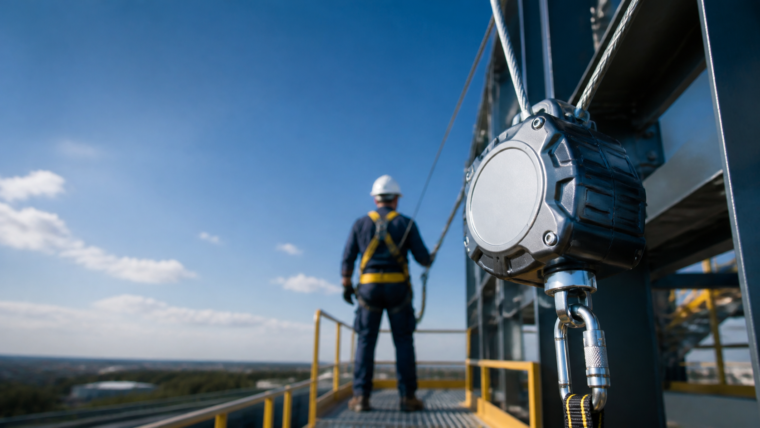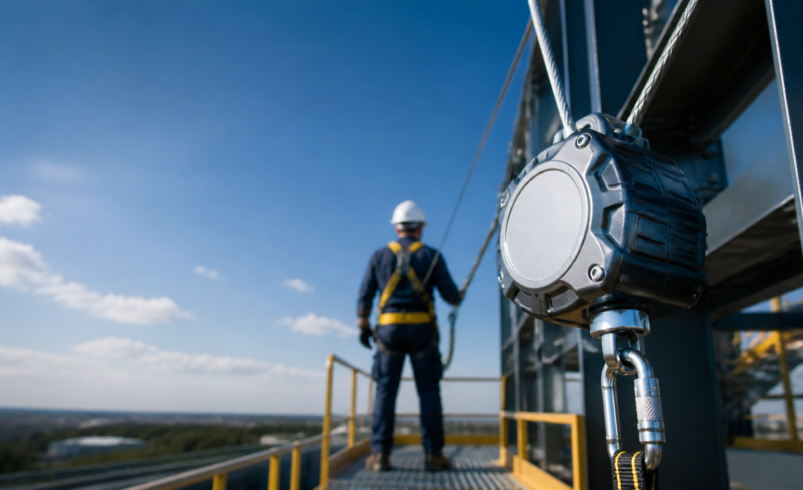

Working at height is a common requirement across construction, industrial maintenance, warehousing, oil and gas, and infrastructure projects in the UAE. However, even a minor mistake or equipment failure can lead to serious injuries. This makes selecting the right fall protection equipment essential for maintaining workplace safety. Among the most important safety devices used by professionals is the retractable fall arrester.
Unlike traditional fall protection systems that use fixed-length lanyards, retractable fall arresters automatically adjust their lifeline according to the worker’s movement. They provide greater flexibility while helping reduce the distance a worker may fall. Understanding how these devices operate, their internal components, and their applications can help employers, safety managers, and workers make informed decisions.
What Is a Retractable Fall Arrester?
A retractable fall arrester, also known as a Self-Retracting Lifeline (SRL), is a personal protective equipment (PPE) device designed to protect workers from falling while performing tasks at height.
It consists of a strong cable or webbing line connected to a harness and an anchorage point. The line extends when the worker moves away from the device and automatically retracts when the worker moves closer.
The primary purpose is to keep the lifeline reasonably tensioned and activate a braking mechanism if a sudden fall occurs. These devices are commonly used in construction sites, industrial facilities, maintenance operations, and other workplaces where fall hazards exist.
How Does a Retractable Fall Arrester Work?
Understanding the working mechanism of a retractable fall arrester helps explain why it is an important part of modern height safety systems.
The operation generally involves the following stages:
1. Automatic Lifeline Extension
Inside the device, a spring-loaded drum stores the cable or webbing. When a worker moves away from the anchorage point, the lifeline automatically extends to accommodate the movement.
This allows workers to perform different tasks without manually adjusting a traditional lanyard. The spring mechanism maintains tension and helps prevent unnecessary slack in the lifeline.
2. Automatic Retraction
When the worker moves closer to the anchorage point, the internal spring mechanism pulls the lifeline back into its housing.
This automatic retraction helps keep the cable organized and reduces the possibility of it becoming tangled or creating a tripping hazard.
3. Fall Detection and Locking Mechanism
The most important feature is the internal fall detection system. During normal movement, the lifeline extends and retracts freely. However, when a sudden acceleration occurs due to a fall, the locking mechanism activates.
Depending on the design, this mechanism may use centrifugal force or another speed-sensitive locking system. It quickly stops the lifeline from extending further.
4. Energy Absorption
Once the braking mechanism engages, the device’s energy absorption system helps control the forces generated during a fall.
This reduces the impact transmitted to the worker’s body and the connected anchorage system. The complete system must be compatible and properly selected to provide effective protection.
Key Components of a Retractable Fall Arrester
A retractable fall arrester contains several components that work together to provide reliable fall protection.
- Housing: Protects the internal mechanical components from environmental exposure and physical damage.
- Lifeline: A strong steel cable or synthetic webbing that connects the worker to the device.
- Spring Mechanism: Controls automatic extension and retraction.
- Braking System: Detects sudden movement and locks the lifeline during a fall.
- Energy Absorber: Helps limit the forces generated during fall arrest.
- Connector: Attaches the device to a suitable anchorage point or compatible harness connection.
Regular inspection of these components is essential to ensure that the equipment remains suitable for use.
Applications of Retractable Fall Arresters in the UAE
The UAE has extensive construction, infrastructure, manufacturing, and industrial maintenance activities. Workers in these sectors frequently perform tasks at elevated positions, making suitable fall protection systems necessary.
Common applications include:
- Construction: Protecting workers installing structural steel, roofing systems, and elevated building components.
- Oil and Gas: Supporting maintenance and inspection activities at industrial facilities.
- Warehousing: Providing fall protection during work on elevated storage structures.
- Industrial Maintenance: Helping technicians work safely on platforms, machinery, and elevated installations.
- Infrastructure Projects: Supporting workers involved in bridge, tower, and other elevated structural maintenance.
The appropriate device depends on the working environment, anchorage arrangement, clearance requirements, and potential fall hazards.
How to Choose the Right Retractable Fall Arrester
Selecting suitable fall protection equipment requires more than checking its price or cable length. Employers and safety professionals should consider several important factors.
- Working Height and Clearance: Check the available fall clearance to ensure the device can arrest a fall before the worker contacts the ground or another obstruction.
- Lifeline Material: Steel cable models are commonly suitable for demanding industrial environments, while webbing models may offer greater flexibility for specific applications.
- Weight Capacity: Verify that the device is approved for the intended user’s weight, including clothing, tools, and additional equipment.
- Certification and Standards: Check compliance with applicable standards, such as EN 360 for retractable-type fall arresters, and relevant UAE workplace safety requirements.
- Working Environment: Consider exposure to dust, moisture, chemicals, heat, and other environmental conditions that may affect equipment performance.
- Inspection and Maintenance: Choose equipment that can be inspected, maintained, and serviced according to the manufacturer’s instructions.
Safety Tips for Using Retractable Fall Arresters
Even high-quality lifting equipment and fall protection devices cannot guarantee safety when used incorrectly. Follow these precautions:
- Inspect the housing, lifeline, connectors, and braking indicators before use.
- Connect the device to an approved anchorage point.
- Use a compatible full-body safety harness.
- Follow the manufacturer’s instructions for installation and operation.
- Avoid using equipment that has suffered a fall until it has been inspected and cleared by an authorized person.
- Develop a suitable rescue plan before starting work at height.
Proper worker training and regular equipment inspections are equally important for maintaining a safe working environment.
Conclusion
Understanding retractable fall arrester working mechanisms helps businesses and safety professionals make better decisions when selecting fall protection equipment. From automatic lifeline adjustment to rapid fall detection and energy absorption, each component plays an important role in protecting workers at height.
For construction, industrial, and infrastructure projects across the UAE, investing in appropriate safety equipment, proper training, and regular inspections is essential. Explore reliable lifting equipment and fall protection solutions to support safer and more efficient workplace operations.
Frequently Asked Questions (FAQs)
1. What is the main purpose of a retractable fall arrester?
A retractable fall arrester is designed to stop a worker from falling freely by automatically locking its lifeline when sudden acceleration occurs. It also allows greater freedom of movement during normal work activities.
2. How does a retractable fall arrester detect a fall?
It uses an internal speed-sensitive locking mechanism. When the lifeline extends rapidly due to a fall, the mechanism activates and prevents further cable or webbing extension.
3. Can a retractable fall arrester be used horizontally?
Some retractable fall arresters are specifically designed and tested for horizontal applications, including potential sharp-edge exposure. Standard models should not be used horizontally unless the manufacturer explicitly approves the application.
4. How often should a retractable fall arrester be inspected?
A pre-use inspection should be performed before every use. In addition, periodic detailed inspections must be conducted by a competent or authorized person at intervals specified by the manufacturer and applicable regulations. Equipment exposed to a fall or showing damage must be removed from service immediately.