


Organizations that screen employees, contractors, caregivers, tenants, volunteers, or platform users often need access to reliable public-registry information. The challenge is that sex-offender registry information in the United States is distributed across numerous individual sources, making nationwide screening more difficult to build and maintain.
An Offender Search API can simplify that process by giving businesses and developers a structured way to incorporate registry screening into existing applications and workflows.
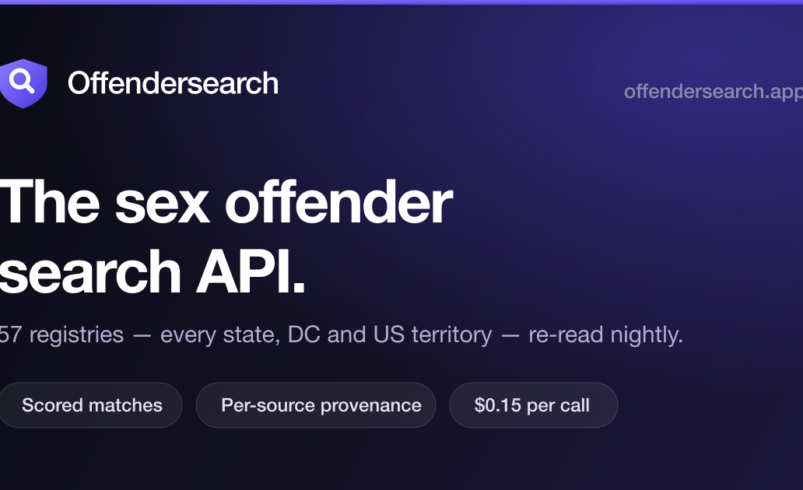
Offendersearch.app provides a nationwide sex-offender registry API designed to help organizations search multiple U.S. registry sources through a single integration. Its platform focuses on normalized data, match scoring, source information, and regularly refreshed records so businesses can build a more efficient screening process.
What Is an Offender Search API?
An Offender Search API is an application programming interface that allows software systems to submit identifying information and receive structured registry-search results programmatically.
Instead of requiring staff members to manually visit multiple registry websites, an API allows the screening process to become part of an existing system.
For example, a company could integrate an offender registry search into:
- Employee onboarding
- Contractor screening
- Volunteer registration
- Tenant screening
- Healthcare credentialing workflows
- Marketplace user verification
- Background-screening platforms
The purpose is not simply to return names. A useful screening API should also help organizations understand where information came from and how strongly a potential result matches the submitted search information.
How Does the Offender Search API From Offendersearch.app Work?
Offendersearch.app provides access to 57 U.S. sex-offender registry sources through one API. The platform normalizes registry information so developers do not have to maintain separate integrations for individual state sources.
This centralized approach can simplify development considerably.
Rather than maintaining dozens of different data connections, an organization can send requests through one API and receive structured results in a consistent format.
Offendersearch.app also provides match-confidence information and source provenance. These features help users evaluate potential matches and understand which registry source contributed the information.
Why Nationwide Registry Screening Can Be Difficult
Registry screening sounds straightforward until an organization attempts to operate across multiple states.
Different registry sources may structure information differently. Data formats, available fields, search systems, and update practices may vary.
For a developer or background-screening provider, building individual integrations for numerous registry systems can create significant maintenance work.
A change to one data source may require development work. Another source may format a name or address differently. An organization operating nationwide may therefore find itself maintaining a large collection of integrations.
The Offender Search API offered through Offendersearch.app is designed to reduce this complexity by creating one normalized data layer over the registry sources it supports.
One Integration Instead of Multiple Registry Connections
One of the major advantages of using an API-based screening service is technical simplicity.
Without a centralized API, developers may need to build and maintain different connections for separate state registries.
That can increase:
- Engineering workload
- Integration complexity
- Maintenance requirements
- Data-normalization challenges
- Operational costs
Offendersearch.app addresses this problem by offering a single API through which supported registry sources can be searched.
This model can be especially useful for companies that operate across several states or serve customers nationally.
Why Match Confidence Matters
A name alone may not be enough to establish whether a registry record belongs to the individual being screened.
Common names can produce multiple potential results.
That is why match evaluation is an important part of registry screening.
Offendersearch.app provides fields such as matchConfidence and matchBasis, which are intended to help users understand how the system evaluated a possible match.
This additional context can help screening teams distinguish between a potentially relevant record and a weaker match that may require further verification.
Automated scoring should still be used carefully. Organizations should establish their own verification and decision-making procedures rather than treating every possible match as definitive.
Source Provenance Creates Greater Transparency
Knowing where registry information came from can be just as important as receiving the information itself.
Offendersearch.app includes per-source provenance within its screening results.
Source provenance helps organizations understand which registry contributed a record.
That can be valuable when a potential result needs additional review because the organization can identify the underlying registry source and perform further verification when appropriate.
For screening providers, documented source information can also make results easier to explain to customers or internal compliance teams.
Regularly Refreshed Registry Information
Screening data becomes less useful if it is not refreshed consistently.
According to Offendersearch.app, its national sex-offender registry data is refreshed nightly, while some use cases can utilize freshness options intended for more frequent re-verification.
The platform also exposes information such as when a record was last checked, helping users understand the freshness of the underlying result.
This is particularly valuable for organizations that need ongoing screening rather than a one-time search.
Offender Search API for Background-Screening Providers
Background-screening companies and consumer reporting agencies may have particularly strong reasons to use a centralized registry API.
Maintaining separate state-level integrations requires technical resources and continuous maintenance.
Offendersearch.app specifically positions its API as a registry data layer for background-screening providers and CRAs. Its offering includes normalized registry access, confidence scoring, source provenance, and a compatibility endpoint designed to make migration from another integration easier.
For screening platforms, these capabilities can reduce infrastructure complexity while allowing registry data to be incorporated into broader background-screening products.
Offender Search API for Staffing and Recruiting
Employers and staffing agencies often need screening procedures that can fit naturally into candidate onboarding.
Manually checking numerous registries can become difficult when candidate volume increases.
An API allows registry screening to be integrated directly into a recruitment or onboarding platform.
Offendersearch.app presents staffing and recruiting as one of its primary use cases, enabling organizations to screen candidates across supported U.S. sex-offender registry sources through a single API request.
This can help organizations create a more consistent screening workflow across different locations.
Screening for Healthcare and Home Care
Healthcare and home-care organizations frequently work with individuals who may enter private homes or interact with vulnerable populations.
For these organizations, registry screening may form one part of a broader credentialing and background-check process.
Offendersearch.app provides an industry-specific solution for screening clinicians, aides, and in-home caregivers through nationwide registry data. The company also makes clear that sex-offender registry screening is intended to complement rather than replace broader credentialing checks.
That distinction is important.
An Offender Search API is a specialized screening tool and should generally be incorporated into a wider risk-management process when additional background checks are appropriate.
Offender Search API for Schools and Childcare Organizations
Schools, childcare providers, youth programs, and related organizations often screen employees, substitutes, contractors, and volunteers.
Managing those checks manually can become difficult when an organization has multiple locations or large numbers of participants.
A centralized registry API can help create a more repeatable process.
Offendersearch.app identifies schools and childcare organizations as a major use case for its nationwide registry-screening service.
The API model allows screening functionality to become part of an organization’s existing administrative or onboarding system.
Supporting Nonprofits and Volunteer Organizations
Nonprofit organizations may rely heavily on volunteers.
Depending on the organization’s activities, those volunteers may work with children, elderly individuals, community members, or other vulnerable populations.
Offendersearch.app supports volunteer-oriented organizations by providing nationwide sex-offender registry screening without requiring separate integrations with individual state systems.
This can be particularly useful for organizations experiencing seasonal increases in volunteer applications or managing participants across multiple locations.
Property Management and Tenant-Screening Workflows
Property-management companies may also incorporate registry information into certain screening processes where appropriate and legally permitted.
The advantage of an API is that a registry search can be integrated into an existing tenant-screening workflow rather than handled through a separate manual process.
Offendersearch.app lists property management among the industries its API is designed to support, offering scored and source-tagged results through a nationwide registry search.
Organizations using such information should ensure that their procedures comply with applicable federal, state, and local requirements.
Gig Platforms and Online Marketplaces
Digital marketplaces often onboard large numbers of providers, hosts, drivers, contractors, or other users.
At that scale, manual checks may not be practical.
An Offender Search API allows a platform to integrate registry screening directly into signup or trust-and-safety workflows.
Offendersearch.app specifically supports gig platforms and marketplaces that want to screen participants at onboarding or conduct recurring checks as part of ongoing trust and safety programs.
This API-driven model is particularly valuable for technology companies because screening can occur within the same automated infrastructure used for other onboarding activities.
Why Developers Benefit From a Structured API
Developers usually want predictable data structures and as few external integrations as possible.
A centralized Offender Search API can reduce engineering work by providing one consistent interface.
Instead of writing different logic for numerous registry sources, developers can build against one API specification and process normalized results.
For technology teams, this can mean:
- Faster implementation
- Less integration maintenance
- Consistent response structures
- Easier nationwide expansion
- Better source tracking
- More scalable screening workflows
Offendersearch.app also offers a compatibility endpoint intended to help existing screening providers change data providers with limited integration changes.
Screening Should Include Verification and Human Review
Technology can make registry screening faster, but it should not eliminate appropriate review.
Names can overlap. Personal information can change. Records can require additional verification.
Organizations should therefore use potential API matches as part of a responsible screening process rather than making significant decisions solely from an automated result.
Source provenance and match-confidence information can assist with this process by giving reviewers more context about potential matches.
Businesses should also consider their applicable legal, regulatory, privacy, employment, housing, and consumer-reporting obligations before creating policies based on registry information.
Choosing the Right Offender Search API
Organizations evaluating an offender registry API should look beyond whether the service simply returns search results.
Important considerations can include:
- Nationwide registry coverage
- Data freshness
- Match-confidence information
- Source provenance
- API documentation
- Integration simplicity
- Scalability
- Verification capabilities
Offendersearch.app combines these capabilities around a single nationwide sex-offender-registry data layer, with 57 registry sources, normalized results, scored matches, provenance, and regularly refreshed data.
Build a More Efficient Screening Workflow With Offendersearch.app
Organizations should not have to maintain numerous separate registry integrations simply to build a nationwide screening process.
The Offender Search API from Offendersearch.app provides developers, screening companies, employers, healthcare organizations, schools, nonprofits, property managers, and online platforms with a centralized way to incorporate U.S. sex-offender registry searches into their existing workflows.
With one API, normalized registry data, match-confidence information, source provenance, and regularly refreshed records, Offendersearch.app is designed to make nationwide registry screening more manageable for organizations that need reliable access at scale.
For businesses building or improving a screening platform, an API-first approach can reduce technical complexity while providing the information needed for more structured review and verification.