

A package can look perfectly fine sitting on a shelf.
That does not necessarily mean it is doing its job well.
The real test begins when someone has to pick it up, move it, store it, display it, transport it, or sell it. A beverage package spends much of its life being handled by people who were never involved in designing it.
That changes the question.
Instead of asking whether packaging looks good, it is worth asking a more practical question: What does this package need to do?
For beverages, the answer is rarely just one thing.
A Beverage Package Has a Journey
A can or bottle does not simply appear in front of a customer.
It has a journey.
It may leave a production facility, move through distribution, arrive at a store, spend time in storage, reach a display, and eventually leave with a customer. Along the way, different people may handle the same product several times.
Every step creates a different requirement.
A package that works well for transportation needs to make sense for transportation. A package designed for retail needs to work within the space and workflow of a store. Something intended for customers to carry needs to be convenient to pick up and move.
The beverage itself may not change.
The job surrounding it does.
The Customer Sees the Last Step
Customers usually experience only the final part of the packaging journey.
They see a six-pack on a shelf. They pick up a carrier containing bottles. They carry several drinks from one place to another.
They do not see the warehouse worker who moved the case earlier. They do not see the retailer organizing inventory. They do not see how the product was packaged before reaching the store.
Yet all of those steps depend on packaging that works.
This is why packaging can be easy to underestimate. When everything works smoothly, there is very little to talk about.
The package simply does what it is supposed to do.
Different Drinks Create Different Problems
There is no universal answer to beverage packaging because beverages are not all packaged the same way.
Cans have different handling characteristics from glass bottles. A group of small containers may need a different carrier from a collection of larger bottles. A product sold individually has different requirements from one sold in multipacks.
Even the number of containers changes the equation.
A four-pack, six-pack, or eight-pack can create different expectations for carrying, storage, and display. A tray may make sense in one situation, while a carrier designed for individual cans or bottles may make more sense in another.
The important thing is not choosing packaging because a particular format is popular.
It is choosing a format that fits the job.
Convenience Is Not an Accident
When a package feels convenient, it can seem almost effortless.
That is part of what makes good packaging easy to overlook.
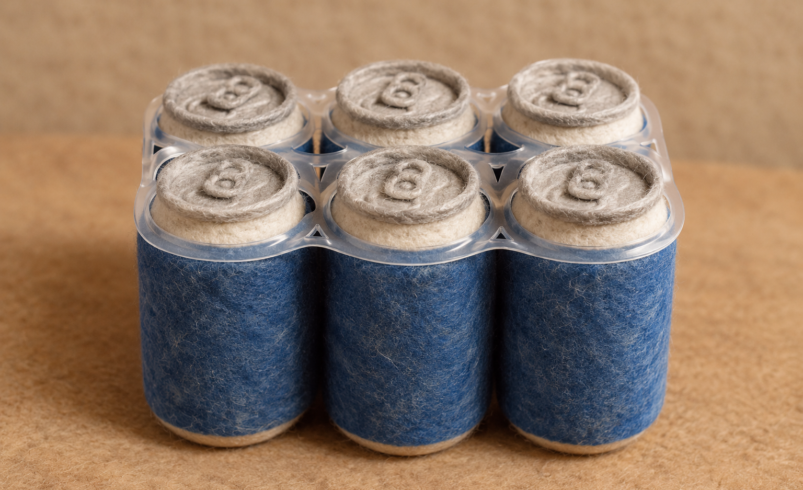
A six-pack carrier allows several cans to be moved together. A bottle carrier can make a group of bottles easier to transport. A tray can help keep products organized during handling and display.
None of these functions are particularly dramatic.
But convenience rarely needs to be dramatic.
Small improvements in handling can matter because packaging is touched repeatedly. A package may be moved dozens of times before the customer ever sees it.
What feels like a small detail can become a recurring part of a business’s daily routine.
Packaging Has to Work for More Than One Person
One of the easiest mistakes is thinking only about the final customer.
A beverage package has several audiences.
There is the person who packages the product. There is the person who transports it. There is the retailer who receives and displays it. There is the customer who eventually buys and carries it.
Each person interacts with the package differently.
A design that makes sense from one perspective may create difficulties somewhere else.
That is why practical packaging decisions often involve more questions than appearance. How will it be handled? Where will it be stored? How will it be displayed? How many units need to be moved at once? Will the product be packaged manually or with equipment?
The answers can change what makes sense.
Packaging Equipment Changes the Conversation
For some businesses, packaging is a manual process.
For others, production volumes make packaging equipment an important part of the operation.
Once machines enter the picture, packaging becomes closely connected to workflow. The packaging format, equipment, speed, product dimensions, and handling process all have to work together.
This is one reason beverage packaging includes more than carriers and packaging materials.
It also includes the equipment and parts that help businesses apply packaging consistently.
Companies such as MUMM Products operate across this broader category, offering beverage packaging products alongside packaging machines and parts. The larger lesson is that packaging is often connected to the entire process rather than being an isolated material at the end of production.
The Best Packaging Is Not Always the Most Noticeable
There is a strange quality to successful packaging.
The better it fits the situation, the less attention it may receive.
Customers do not usually stop to admire the carrier that makes a six-pack easier to carry. A store employee does not necessarily think about every package that makes stocking easier. A distributor may not spend much time thinking about packaging when everything moves smoothly through the process.
That does not make those details unimportant.
It means the packaging is doing its job quietly.
And quiet success is still success.
A Better Question to Ask
Instead of asking whether a package looks good, businesses can start with a more useful set of questions.
Who will handle it?
Where will it go?
How many units need to move together?
How will it be displayed?
What happens when the customer takes it home?
These questions do not produce one universal answer.
They produce a better understanding of the problem.
And that is usually where good packaging decisions begin.
Because packaging is not simply the thing around a beverage.
It is part of the journey the beverage has to make.