
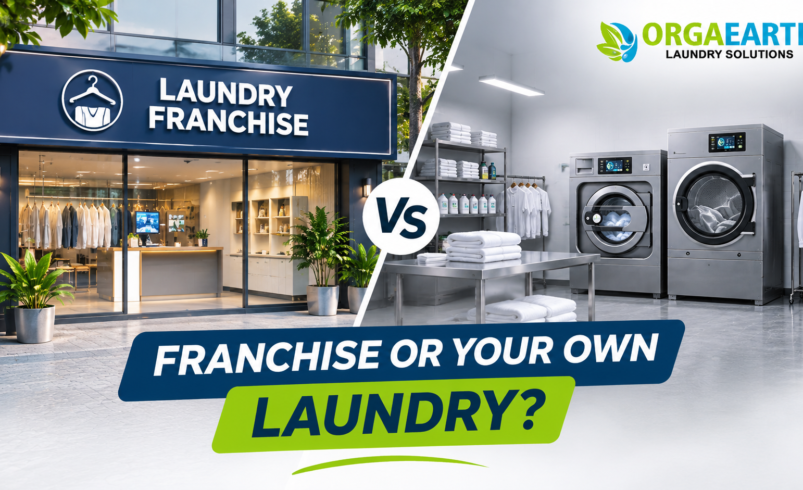

Starting a laundry business in India involves an important decision: should you invest in an established franchise or build your own independent laundry shop?
Both options offer opportunities, but their costs, responsibilities and long-term returns can differ significantly.
A franchise may provide brand recognition, training and operating systems. An independent business gives you greater freedom over pricing, equipment, services and marketing.
Before making a decision, understanding the actual laundry business setup cost, recurring expenses and expected customer demand is more important than choosing a business model based on popularity alone.
What Is the Difference Between a Laundry Franchise and an Independent Laundry Shop?
A laundry franchise operates under an established company’s brand and business agreement. Depending on the contract, the franchisor may provide training, marketing support, software and equipment recommendations.
An independent laundry shop operates under its own name. The owner manages everything from equipment purchasing to customer acquisition and daily operations.
| Factor | Laundry franchise | Independent laundry shop |
| Brand identity | Established brand | Owner’s own brand |
| Franchise fees | Usually applicable | Not applicable |
| Equipment selection | May be restricted | Owner’s choice |
| Marketing | Brand support may be available | Managed independently |
| Business decisions | Subject to agreement | Greater flexibility |
| Training | May be included | Arranged separately |
Neither model guarantees profitability. Customer demand, service quality and operating costs remain important in both.
How Much Does a Laundry Business Setup Cost in India?
Initial investment depends on the business format, location, equipment capacity and services offered.
A collection centre that outsources garment processing requires a different budget from a complete shop with commercial washing, drying and dry-cleaning machines.
For a franchise, expenses may include brand fees, machinery, interiors, software, shop deposits and working capital.
An independent outlet avoids franchise fees but must independently arrange branding, training, marketing and technical support.
Published Indian franchise packages vary considerably, with some starting around ₹13–14 lakh and others exceeding ₹20 lakh. These advertised figures may not cover every project expense.
Before comparing quotations, request a complete breakdown covering machinery, installation, rent deposits, utilities and initial operating expenses.
What Extra Fees Should You Check Before Buying a Laundry Franchise?
The initial franchise investment is not necessarily the total cost of operating the business.
Some agreements include recurring royalty payments, marketing contributions, software subscriptions or approved supplier requirements.
For example, a franchise charging a hypothetical 7% royalty on ₹3 lakh monthly revenue would collect ₹21,000 each month.
That expense must be considered alongside rent, salaries, electricity, chemicals and maintenance.
Ask whether the franchise fee includes equipment installation, operator training, promotional support and future technical assistance.
Always review renewal fees, termination terms and equipment ownership before signing the agreement.
Which Is More Profitable: A Laundry Franchise or an Independent Laundry Business?
Profitability depends on revenue and the cost of delivering each service.
A franchise may benefit from customer familiarity and established operating procedures. However, recurring fees can reduce the amount retained by the business.
An independent shop avoids royalties but may need greater investment in advertising, customer acquisition and staff development.
Consider this simplified monthly comparison:
| Monthly expense | Franchise | Independent |
| Revenue | ₹3,00,000 | ₹3,00,000 |
| Common operating costs | ₹2,10,000 | ₹2,10,000 |
| Assumed franchise royalty | ₹21,000 | ₹0 |
| Balance before other expenses | ₹69,000 | ₹90,000 |
These are hypothetical figures, not projected profits. They exclude financing, tax, depreciation and differences in marketing or other costs.
The important question is whether the franchise’s support helps generate enough additional business to justify its fees.
What Machines Are Needed for an Independent Laundry Business Setup?
Equipment selection depends on whether the shop provides wash-and-fold, ironing, dry cleaning or specialised garment-care services.
A processing outlet may require:
- Commercial washing machines or washer extractors
- Tumble dryers matched to washing output
- Pressing tables and finishing equipment
- Spotting equipment for suitable stain-treatment work
- Chemical dosing and garment-handling systems
A collection-only outlet may not require on-site washing machinery.
For an independent business, selecting machines according to expected daily orders helps avoid paying for unnecessary capacity.
Entrepreneurs should also consider machine servicing, water supply, drainage, electrical connections and staff skills before purchasing equipment.
How Long Does It Take to Recover a Laundry Shop Investment?
Investment recovery depends on how much cash the business generates after paying its expenses.
Suppose an entrepreneur invests ₹15 lakh and generates a sustainable monthly cash surplus of ₹50,000.
Estimated payback period = ₹15,00,000 ÷ ₹50,000 = 30 months
This is a simplified example, not a guaranteed return.
Actual payback can change because of seasonal demand, equipment repairs, loan repayments, customer acquisition costs and unexpected expenses.
It is also important to distinguish operating break-even from recovering the original investment.
A shop may cover its monthly expenses long before it has recovered its startup capital.
Does a Laundry Franchise Offer Better Support Than an Independent Business?
A franchise may provide standard operating procedures, staff training, billing systems and promotional materials.
However, the level of support differs between brands.
Prospective franchisees should speak with existing operators and verify the services promised in the agreement.
Independent laundry owners can obtain professional equipment, technical support and training through separate suppliers and service providers.
The difference is not simply whether support exists, but how it is delivered, what it costs and whether it meets the business’s requirements.
What Should You Check Before Signing a Laundry Franchise Agreement?
Before committing your money, review the complete commercial arrangement.
Important questions include:
- What is included in the initial franchise fee?
- Are monthly royalties or marketing charges applicable?
- Can equipment and chemicals be purchased from other suppliers?
- Who owns the machinery if the agreement ends?
- Is the franchise territory protected?
- What happens during early termination or renewal?
- Can you review actual operating results from comparable outlets?
An independent business requires similar financial planning, even without a franchise agreement.
Both models should begin with local demand research and realistic operating projections.
Should a First-Time Entrepreneur Choose a Franchise or Start Independently?
A franchise may appeal to someone who prefers established systems and structured onboarding.
An independent shop may suit an entrepreneur who wants to control service offerings, equipment selection and brand development.
Location also matters. A residential neighbourhood may have different requirements from an area serving hostels, hotels or corporate customers.
Before choosing either model, estimate the number of orders needed to cover monthly expenses.
The better investment is the one that fits your budget, management capabilities and actual local customer demand.
How OrgaEarth Can Help With Your Laundry Business Setup
OrgaEarth Laundry Solutions helps entrepreneurs plan professional laundry and dry-cleaning operations through commercial equipment selection and installation support.
Its range includes commercial washers, dryers, pressing equipment and machinery for different garment-care requirements.
Whether you are evaluating franchise equipment or planning an independent shop, the right combination should reflect expected processing volumes, available utilities and the services you intend to offer.
Entrepreneurs can explore Orgaearth’s commercial laundry business setup solutions to compare equipment combinations for retail laundries and dry-cleaning businesses.
Conclusion: Which Laundry Business Model Is the Better Investment?
A laundry franchise offers the potential benefits of brand recognition, structured procedures and business support. An independent laundry shop provides greater flexibility and avoids franchise royalties.
Neither option is automatically more profitable.
The right choice depends on total investment, recurring expenses, local competition and your ability to manage daily operations.
Before investing, compare complete project costs, realistic revenue projections and equipment requirements.
A carefully planned laundry business has a stronger foundation than one built around brand recognition or a low initial quotation alone.
Frequently Asked Questions
1. Is a laundry franchise profitable in India?
A laundry franchise can be profitable when customer revenue exceeds operating expenses, franchise fees and other costs. Profitability depends on location, demand, service quality and financial management.
2. How much investment is required for an independent laundry business setup?
Investment varies according to city, shop format, machinery and processing capacity. A collection centre generally requires a different budget from a fully equipped laundry and dry-cleaning shop.
3. Can I start a laundry business without buying a franchise?
Yes. Entrepreneurs can establish their own laundry brand, purchase suitable commercial machines and independently manage services, pricing, employees and marketing.
4. Do laundry franchises charge monthly royalties?
Some laundry franchises charge royalties or other recurring fees, while others use different commercial arrangements. Always confirm the current terms in writing.
5. Which commercial machines are required for a small laundry shop?
A processing shop may require commercial washers, tumble dryers, pressing equipment and garment-handling systems. The exact machinery depends on expected demand and services offered.
6. How long does a laundry business take to break even?
Operating break-even depends on monthly revenue, fixed expenses and contribution margins. Recovering the initial investment may take considerably longer and should be calculated separately.
Contact Us:
Orgaearth Laundry Solutions
Plot no. 774, Udyog Vihar, Phase 5, Gurugram, Haryana, India-122016
Email: marketing@orgaearth.com
Contact No. +91 7042912777