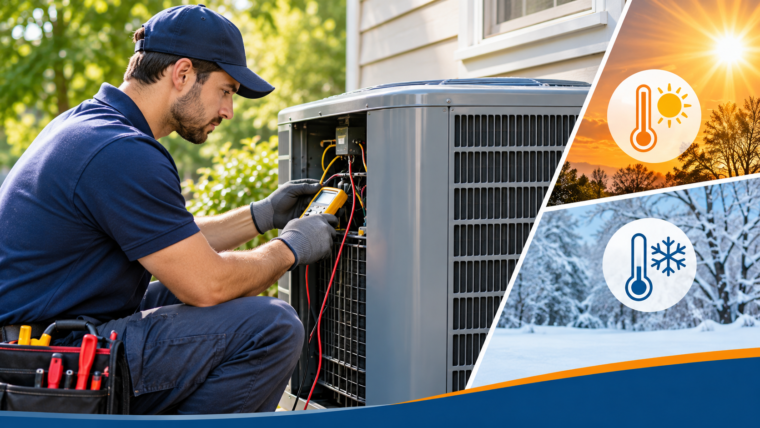

Most HVAC systems don’t fail because they’re old. They fail because small problems go unnoticed until the system is running at its hardest. The week a heat wave arrives or temperatures drop below freezing is exactly when a stressed, undermaintained system gives out. Seasonal HVAC maintenance is the straightforward way to stop that from happening, and the best time to do it is before the weather forces the issue.
This isn’t about following a schedule for its own sake. It’s about understanding what actually degrades inside a heating or cooling system between seasons, what a technician looks for during a tune-up, and why catching those things early changes the outcome significantly.
What Changes Inside a System When the Seasons Shift
Heating and cooling equipment sits idle for months at a time. During that dormancy, things move, settle, and deteriorate in ways that aren’t visible from the outside. Electrical contacts oxidize. Lubricant in motors dries out. Dust accumulates on coils and burners. Refrigerant lines can develop slow leaks. None of these problems announce themselves until the system is asked to run hard under real load.
Seasonal temperature changes also affect thermostat calibration. A thermostat that read accurately in mild weather may cycle the system incorrectly when outdoor temperatures become extreme, causing the equipment to short-cycle, overwork, or simply fail to reach the set temperature. Checking thermostat settings and calibration is one of the first things a technician addresses during a tune-up, and it’s one of the things homeowners most often overlook on their own.
The outdoor condenser unit faces its own set of challenges. Debris accumulates around and inside the cabinet over winter. Fins bend, coils get coated in grime, and the fan motor’s capacitor weakens. A weakened capacitor is one of the leading causes of compressor failure during the first hot days of summer, and it’s completely undetectable without voltage testing equipment.
Spring AC Inspection: What Actually Gets Checked
A spring AC inspection done properly is not a filter swap and a visual look-around. A trained technician measures refrigerant charge and checks for leaks, tests capacitor voltage on both the compressor and fan motor, cleans the evaporator and condenser coils, checks the blower motor’s amperage draw, and verifies that airflow across the indoor coil is within the correct range. Each of those checks catches a specific failure mode before it becomes a no-cooling situation in July.
Refrigerant level matters more than most homeowners realize. A system running with low refrigerant doesn’t just cool less effectively. It causes the evaporator coil to ice over, which blocks airflow entirely, and it forces the compressor to work outside its designed operating range. Over time, that kills the compressor, and compressor replacement is one of the most expensive repairs in residential HVAC. A heating and cooling tune-up that catches a small refrigerant leak in April costs far less than an emergency compressor call in August.
Cooling performance also depends on coil cleanliness in a way that’s easy to underestimate. A thin layer of dust on the evaporator coil reduces heat transfer efficiency noticeably. A heavily fouled condenser coil can raise head pressure enough to trip the system’s safety switches. Neither problem is obvious from the outside, and neither gets better on its own.
Fall Furnace Inspection: The Safety Case and the Efficiency Case
The fall furnace inspection carries higher stakes than the spring check, primarily because combustion equipment introduces risks that cooling systems don’t. A cracked heat exchanger, a failing ignition system, or a blocked flue can all produce carbon monoxide exposure or fire conditions. These aren’t theoretical risks. They’re the reason gas utilities and fire safety organizations consistently recommend annual furnace inspections before heating season begins.
On the efficiency side, heating efficiency degrades in measurable ways when burners are dirty, the blower motor is struggling, or the heat exchanger surface is coated with residue. A furnace running at reduced efficiency costs more to operate and reaches set temperature more slowly, which compounds during the coldest days of the year when the system runs nearly continuously.
During a fall heating and cooling tune-up, a technician checks ignition components, inspects the heat exchanger for cracks, tests the pressure switch and limit controls, measures the temperature rise across the heat exchanger, and verifies that the flue is clear and drawing correctly. These are not steps a homeowner can replicate with a flashlight and a filter.
The Difference Between Preventive Servicing and Reactive Repair
The practical argument for preventive servicing comes down to timing and cost. A capacitor replaced during a scheduled tune-up costs a fraction of what an emergency service call costs when the same capacitor fails on a Saturday afternoon in a heat wave. Beyond the direct cost, there’s the availability problem: during extreme weather events, HVAC contractors are booked days out. Homeowners who haven’t maintained their systems are the ones waiting in the heat or cold for service that isn’t immediately available.
There’s also the equipment lifespan argument. HVAC systems that receive consistent seasonal HVAC maintenance tend to reach and exceed their expected service life. Systems that run without attention tend to accumulate deferred problems that compound. A blower motor running with degraded bearings draws more current, which stresses the control board, which can cause a cascade of failures that a single tune-up would have prevented.
| What Gets Checked | Why It Matters | What Happens Without It |
| Capacitor voltage (cooling season) | Weak capacitors cause compressor failure | Compressor fails under peak load |
| Refrigerant charge | Low charge damages compressor and reduces cooling performance | Iced coil, poor cooling, early compressor failure |
| Heat exchanger inspection | Cracks allow combustion gases into living space | Carbon monoxide risk, system lockout |
| Ignition system test | Failing igniters cause no-heat calls | Furnace doesn’t start on first cold night |
| Coil cleaning | Fouled coils reduce system performance and raise operating pressure | Higher utility bills, safety switch trips |
| Thermostat calibration | Miscalibrated thermostats cause short-cycling and comfort complaints | System runs inefficiently at temperature extremes |
| Outdoor condenser unit clearance | Blocked airflow raises head pressure and reduces efficiency | Reduced cooling capacity, potential compressor damage |
What Homeowners Can and Can’t Do Themselves
Some preparation steps are genuinely within reach for most homeowners. Replacing the air filter before the heating or cooling season begins is straightforward and makes a real difference in airflow. Clearing debris from around the outdoor condenser unit, making sure supply and return vents aren’t blocked by furniture, and checking that thermostat settings are appropriate for the coming season are all reasonable DIY steps.
What homeowners cannot do safely or effectively: measure refrigerant charge, test capacitor voltage, inspect a heat exchanger for cracks, or evaluate combustion safety. These tasks require specific tools, EPA certification for refrigerant handling, and the kind of pattern recognition that comes from inspecting many systems. Attempting them without that background doesn’t just risk injury. It can damage equipment in ways that aren’t immediately apparent.
The honest boundary is this: homeowners can maintain airflow and cleanliness around the system. The internal mechanical and electrical checks that actually prevent failures require a licensed technician.
Timing Seasonal Maintenance to Get the Most Out of It
The timing of seasonal HVAC maintenance matters more than most homeowners expect. Scheduling a spring AC inspection in April or early May, before cooling demand starts, gives the system time for any needed repairs before the first heat wave. Scheduling a fall furnace inspection in September or early October does the same for heating season. Both windows also tend to be less busy for contractors, which means more scheduling flexibility and often faster turnaround on any parts that need ordering.
Waiting until the system has already been running for weeks under peak load is a common mistake. By that point, any existing weaknesses have already been stressed, and the contractor’s schedule is compressed by homeowners in the same situation. Proactive seasonal HVAC maintenance is partly a logistics decision, not just a technical one.
Homeowners who want professional help scheduling and completing these inspections before the next weather extreme arrives can explore Professional HVAC Tune-Up Services to get connected with a licensed local contractor in their area. Getting ahead of the season by even a few weeks is usually the difference between a routine service call and an emergency one.