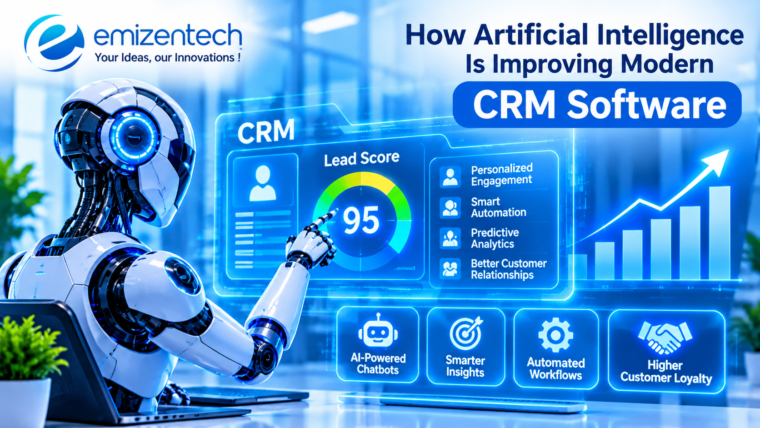

Customer relationship management has moved far beyond contact lists and deal stages. Modern CRM platforms now use artificial intelligence to predict buyer behavior, automate routine tasks, and surface insights that once took hours of manual analysis. For sales, marketing, and support staff, that means less busywork and more time with customers. This article explains how AI is improving CRM software, where the biggest gains appear, and what to watch for before you adopt it.
How AI Has Changed What a CRM Can Do
A traditional CRM records what has already happened: a call logged, a deal moved, a ticket closed. AI changes the direction of that flow. By learning from historical data, it helps a CRM anticipate what is likely to happen next and suggest what to do about it. Machine learning finds patterns across thousands of records, natural language processing reads emails and chats, and predictive models estimate outcomes such as conversion or churn.
The CRM shifts from a passive database into an active assistant that works alongside every user. That shift matters because customer expectations keep rising. Buyers expect fast, relevant replies, and AI helps organizations deliver them without adding headcount or asking staff to work longer hours.
Key AI Features Found in Modern CRM Software
AI shows up in a CRM in several practical forms. Some are built into the platform, while others are added through integrations or custom development. These are the features that make the biggest difference day to day:
- Predictive lead scoring: AI ranks leads by their likelihood to buy, so reps call the best prospects first.
- Sales forecasting: models study pipeline history and current activity to produce more dependable revenue forecasts.
- Conversational assistants: chatbots answer routine questions, qualify visitors, and book meetings around the clock.
- Automatic data capture: AI logs emails, calls, and meetings into the right records without manual entry.
- Sentiment analysis: the system reads tone in messages and tickets to flag unhappy customers early.
- Next-best-action prompts: AI recommends the right follow-up, offer, or channel for each contact.
- Generative writing help: AI drafts emails, call summaries, and proposals using data already stored in the CRM.
How AI Improves Sales, Marketing, and Customer Support
The real value of AI shows up in daily work, so it helps to look at each department in turn.
In sales, AI improves focus. Reps start the day with a prioritized list, get talking points based on past conversations, and see which deals are at risk before they stall. Managers can coach with insights from call analysis instead of relying on gut feeling, which makes feedback specific and fair.
In marketing, AI improves relevance. It predicts the best time to send a message, recommends content for each contact, and groups audiences by behavior instead of fixed rules. Campaigns feel more personal, and engagement and conversion tend to rise as a result.
In customer support, AI improves speed. Chatbots resolve common questions instantly, tickets are routed to the right specialist, and agents see suggested answers drawn from similar past cases. Customers wait less, and agents spend their energy on the problems that truly need a human.
Built-in features cover the basics, but every sales process has its own quirks. Custom scoring models, tailored workflows, and links to your other systems often need specialist skills. That is why it can pay to hire CRM developer talent who can tailor AI features to your pipeline, connect them to existing tools, and make sure the models learn from clean, well-structured data.
Business Benefits of an AI-Powered CRM
When these features work together, the impact reaches revenue, cost, and customer satisfaction. The most common gains include:
- Higher productivity: automation handles data entry, scheduling, and follow-up reminders, freeing hours every week for real selling.
- Better conversion rates: reps spend their time on the leads most likely to close instead of working through a flat list.
- Stronger retention: early churn signals let customer success step in before a relationship sours.
- More accurate planning: reliable forecasts support better hiring, budgeting, and inventory decisions.
- Consistent experiences: customers receive timely, relevant service across every channel they use.
- Easier scaling: AI absorbs added workload, so growth does not require a matching rise in headcount.
These gains compound over time, because the models keep learning from fresh data and become more accurate with use.
AI Agents: The Next Stage of CRM Automation
The latest shift is from assistants that suggest to agents that act. An AI agent can research a new lead, draft a personalized message, schedule a meeting, update the record, and alert the owner, all within rules you define. Instead of handling one step at a time, agents manage entire workflows from start to finish, which frees staff for conversations and decisions that need human judgment.
Because agents take real actions inside your CRM, design matters. They need clear permissions, approval steps for sensitive tasks, and reliable access to accurate data. Working with a specialist in AI agent development makes it easier to build agents that follow your rules, log every action, and fit naturally into your sales and service processes. A sensible approach is to start with a single task, such as lead follow-up or ticket triage, and expand as trust grows.
Challenges to Plan for Before Adopting AI
AI is powerful, but it is not magic. Results depend on the quality of your data, the way your staff uses the tools, and how well the new features fit your existing systems. Knowing the common obstacles upfront helps you plan around them instead of discovering them mid-project. Here are the ones to watch:
- Poor data quality: duplicates, gaps, and outdated records lead to weak predictions.
- Privacy and compliance: customer data must be handled according to laws such as GDPR and CCPA.
- User trust: reps ignore recommendations they do not understand, so explainable scores matter.
- Integration effort: AI features must connect smoothly with email, marketing, and ERP tools.
- Cost and expectations: results take time, and a small customer base may not justify advanced models yet.
How to Get Started With AI in Your CRM
Begin with one use case tied to a measurable result, such as faster lead response or fewer support escalations. A narrow start keeps risk low and makes success easy to prove to stakeholders who may be skeptical.
Clean your data before turning anything on, because models learn from what you give them. Remove duplicates, standardize fields, and fill in the gaps that matter most. Then pilot the feature with a small group, collect honest feedback, and refine settings before a wider rollout.
Train staff on how recommendations are produced so they trust and use them. Finally, track results against a baseline, such as conversion rate, response time, and hours saved, and expand to new use cases once the first one proves its value. Treat AI as an ongoing improvement rather than a one-time installation.
Conclusion
AI is turning CRM software from a record-keeping tool into a system that predicts, recommends, and acts. It improves lead prioritization, personalizes marketing, speeds up support, and gives leaders forecasts they can rely on. The gains depend on clean data, clear goals, and a thoughtful rollout. To bring these AI capabilities into your own workflow, EmizenTech can help you plan, build, and integrate AI features that match your processes and grow with your business.
Frequently Asked Questions
1. How does AI improve CRM software?
AI automates data entry, scores leads, forecasts revenue, personalizes outreach, and speeds up support. It learns from past customer data to recommend actions, so users spend less time on admin and more time on customers.
2. Do I need a new CRM to use AI?
Not necessarily. Most modern platforms offer AI features, and many existing systems can be extended through integrations or custom development without a full replacement.
3. Is AI in CRM only for large companies?
No. Smaller organizations benefit too, especially from automation and lead prioritization. The key is to start with one practical use case and scale up as the customer base grows.
4. Will AI replace sales and support staff?
Unlikely. AI handles repetitive tasks and offers recommendations, while people still manage relationships, negotiation, and complex problems. The goal is to support staff, not replace them.
5. How long does it take to see results from AI in a CRM?
Simple features such as automatic data capture can show benefits within weeks. Predictive scoring and forecasting usually improve over a few months as models learn from your data.