

The role of corporate social responsibility is changing.
Companies are increasingly looking beyond traditional donations and searching for projects that create measurable, long-term value.
At the same time, communities are looking for practical infrastructure that improves everyday life.
This combination creates an important opportunity around drinking water.
Access to clean drinking water is a basic requirement, yet the way water is delivered can vary greatly between locations.
Schools, public institutions, transport facilities, worker communities, rural areas, and urban neighbourhoods may all require different solutions.
For organisations planning future-focused CSR Activities, modern water dispensing infrastructure can provide one possible approach.
Why Community Water Projects Are Changing
Traditional drinking-water arrangements often depend on manual distribution, packaged bottles, or fixed public taps.
These options can work in certain situations, but changing community needs are creating demand for more organised solutions.
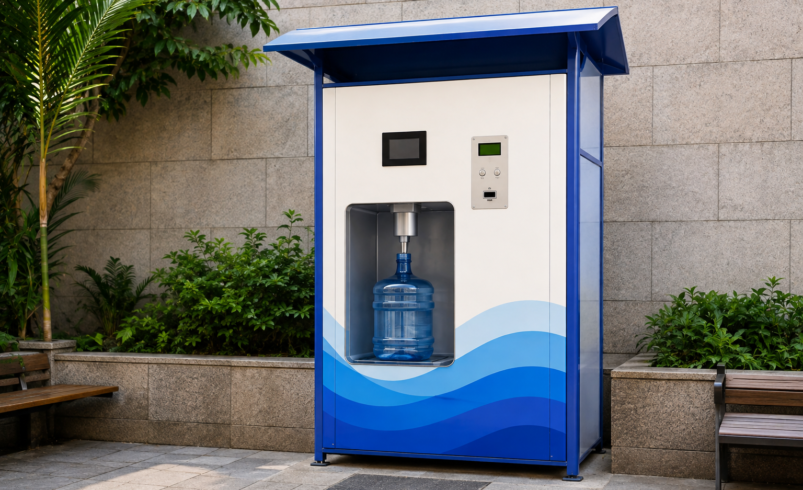
A water ATM can provide controlled dispensing and, depending on its configuration, may support different operating models.
The objective is not to replace every existing drinking-water system.
Instead, it can complement existing infrastructure where a convenient refill or dispensing facility is required.
Technology Should Support People
The most useful technology is technology that solves a real problem.
A community water system should make access easier rather than creating unnecessary complexity.
Users should be able to understand the process quickly.
For public installations, clear instructions and easy access are particularly important.
The machine should also be positioned in a location where people naturally pass through.
Choosing the Right Application
A water vending project can potentially support several environments.
Schools
Students can refill bottles during the school day.
Hospitals
Patients’ attendants and staff can access drinking water.
Railway Stations
Travellers can refill bottles before continuing their journey.
Worker Communities
Employees and their families can access water near residential areas.
Rural Communities
A shared dispensing point can support local drinking-water access where appropriate.
The project should always be designed around the needs of the intended users.
Selecting a Water Vending Machine
A water vending machine should be selected based on actual requirements.
Before making a purchase, organisations should evaluate:
- Daily demand
- Peak usage
- Water quality
- Capacity
- Installation space
- Power availability
- Drainage
- Maintenance requirements
The right machine is not necessarily the most expensive one.
It is the one that matches the environment and expected usage.
Understanding Water Vending Price
Budget planning should go beyond the initial water vending price.
CSR teams should consider the complete lifecycle of the installation.
This can include:
- Equipment purchase
- Installation
- Plumbing
- Electrical requirements
- Treatment components
- Filter replacement
- Maintenance
- Technical support
A project that cannot afford ongoing maintenance may fail to deliver its intended social impact.
Water Quality Monitoring
The future of community water access must remain centred on quality.
The incoming water source should be assessed before selecting the treatment system.
After installation, organisations should establish appropriate monitoring procedures.
Maintenance may include:
- Regular cleaning
- Filter servicing
- Water quality checks
- Storage inspection
- Dispensing outlet cleaning
The exact requirements depend on the system and local water conditions.
The Role of Digital Payments
Some water vending projects may use digital payment systems.
This can be useful where users are expected to pay for water.
However, CSR projects do not necessarily need a commercial model.
A company may choose free access where community welfare is the primary objective.
The operating model should be determined according to the project’s goals and long-term sustainability.
Sustainability and Reusable Bottles
The future of drinking-water access is also connected with responsible consumption.
Refill facilities can encourage people to carry reusable bottles.
This approach can potentially reduce unnecessary dependence on single-use packaged bottles.
Companies can strengthen this message through awareness campaigns alongside infrastructure installation.
Data Can Improve CSR Projects
Modern projects can also use basic operational information to understand performance.
Organisations can monitor:
- Daily usage
- Water dispensed
- Peak demand
- Maintenance requirements
- Downtime
- User feedback
This information can help CSR teams decide whether the facility needs additional capacity, better placement, or more frequent servicing.
Planning for Future Demand
Communities change over time.
A school may add more students.
A worker colony may expand.
A railway station may experience increased passenger traffic.
A public facility may become more popular.
Therefore, future demand should be considered during initial planning.
Where practical, organisations can select systems and infrastructure that allow reasonable expansion.
Creating Partnerships
Large CSR projects do not always need to be managed by one organisation alone.
Companies can work with:
- NGOs
- Local institutions
- Community groups
- Educational organisations
- Healthcare facilities
- Public authorities
Partnerships can help with location selection, community engagement, maintenance, and impact monitoring.
What Makes a CSR Water Project Successful?
A successful project generally combines several elements:
Real need + suitable technology + correct location + proper maintenance + local responsibility + continuous monitoring
Leaving out any one of these can reduce the project’s effectiveness.
The machine itself is only a component.
The overall system is what creates the impact.
Frequently Asked Questions
1. How can CSR Activities support future community needs?
Companies can invest in infrastructure that addresses recurring requirements and remains useful over the long term.
2. Can water ATMs be used for free CSR projects?
Yes. The operating model can be designed according to the project’s social objectives.
3. What should be considered before purchasing a water vending machine?
Water quality, expected demand, capacity, location, electricity, drainage, maintenance, and future requirements should be assessed.
4. How should water vending price be compared?
Compare the complete project and lifecycle cost rather than looking only at the initial machine price.
5. Can reusable bottles be encouraged?
Yes. Refill-oriented facilities can be combined with awareness campaigns promoting reusable containers.
6. Why is monitoring important?
Monitoring helps organisations understand usage, identify problems, and evaluate whether the project is creating the expected impact.
Conclusion
The future of CSR Activities is increasingly focused on measurable and sustainable impact.
Community drinking-water projects fit naturally into this approach because they address a basic need while offering the possibility of long-term use.
A well-planned water ATM or water vending machine can become more than a piece of equipment. It can become part of a school’s infrastructure, a hospital’s visitor facilities, a railway station’s public amenities, or a community’s shared resources.
The real measure of success is simple: whether people continue to benefit from the project long after its installation.
When companies combine thoughtful planning, suitable technology, responsible maintenance, and community participation, CSR can move beyond short-term assistance and become a lasting investment in people’s everyday lives.