
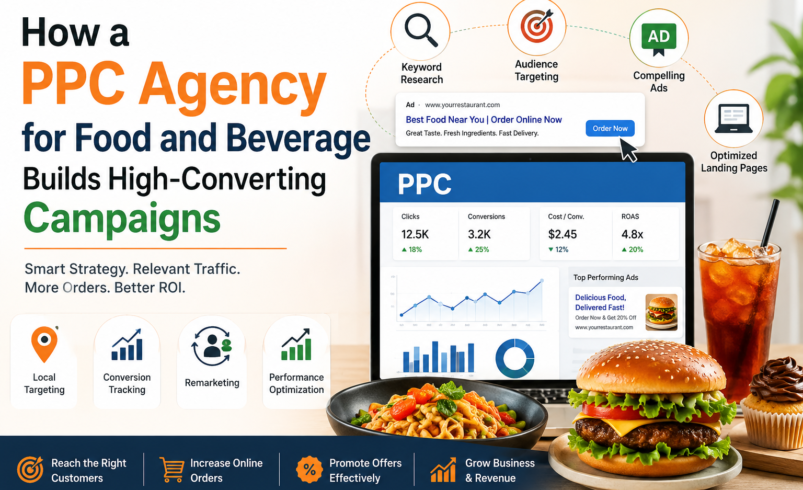

Food and beverage businesses have many opportunities to reach customers online. Whether you run a restaurant, café, bakery, cloud kitchen, catering company, food delivery business, beverage brand, or packaged food company, paid advertising can help you reach people who are ready to order or make a purchase.However, simply creating an advertisement does not guarantee results. A successful PPC campaign needs the right keywords, audience targeting, advertisements, landing pages, budget, and conversion tracking. This is where a PPC agency for food and beverage can help. Agencies such as White Hat SEO Guru and SEO Discovery can support food and beverage businesses with PPC strategies designed around their specific marketing goals and target customers.A professional PPC agency understands how to create campaigns around customer intent and business goals. Instead of spending money on random clicks, the focus is on reaching relevant customers and encouraging them to take action. With proper planning and continuous optimization, PPC can help food and beverage businesses increase online orders, generate leads, promote offers, and grow revenue.
What Is PPC for Food and Beverage Businesses?
PPC stands for pay-per-click advertising. It is a form of online advertising where businesses generally pay when someone clicks on their advertisement.Food and beverage businesses can use PPC to promote different products and services. A restaurant might advertise for people searching for “best Italian restaurant near me,” while a bakery could target searches such as “custom birthday cakes near me.”A packaged food brand may use paid search or shopping campaigns to promote products online. A catering company may advertise searches related to wedding catering or corporate events.The campaign strategy depends on the type of business, target audience, location, products, and goals.
Why High-Converting PPC Campaigns Matter
Getting clicks is only one part of PPC advertising. The real goal is to turn those clicks into meaningful actions.
Depending on the business, a conversion could be:
- An online food order
- A restaurant reservation
- A phone call
- A catering inquiry
- A product purchase
- A form submission
- A store visit
- A newsletter signup
A high-converting campaign is designed around these actions from the beginning.For example, if a restaurant wants more online orders, its campaign should not simply drive visitors to the homepage. The advertisements should take users to a page where they can quickly view the menu and place an order.
1. Understanding the Food and Beverage Business
Before creating advertisements, a PPC agency needs to understand the business.Every food and beverage company has different customers and goals.A fine-dining restaurant may want to attract customers interested in premium dining experiences. A fast-food restaurant may focus on convenience and quick delivery. A bakery may promote custom cakes, while a beverage company may focus on online product sales.
An agency may look at:
- Products and services
- Target customers
- Business location
- Competitors
- Average order value
- Seasonal demand
- Popular products
- Current offers
- Website performance
- Business objectives
This information helps create campaigns that are relevant to the business rather than using a generic advertising approach.
2. Researching High-Intent Keywords
Keyword research is one of the most important parts of PPC.A PPC agency for food and beverage can identify searches that show strong customer intent.For example, someone searching for “best restaurant in Delhi” may be researching options, while someone searching for “order pizza online in Delhi” may be much closer to making a purchase.Depending on the business, relevant keywords could include:
- Restaurant near me
- Order food online
- Best bakery near me
- Birthday cake delivery
- Catering services
- Corporate catering
- Coffee shop near me
- Healthy food delivery
- Buy packaged snacks online
- Premium beverages online
The agency can group keywords according to products, locations, and customer intent to create more focused campaigns.
3. Using Negative Keywords
Not every search related to a food business is useful.For example, a restaurant may not want to show advertisements for people searching for “restaurant jobs,” “restaurant training,” or free recipes.Negative keywords can help prevent ads from appearing for irrelevant searches.This can reduce wasted clicks and protect the advertising budget.An agency can regularly review search term reports and identify irrelevant queries that should be excluded from campaigns.
4. Creating Compelling Advertisements
The advertisement is often the first interaction a potential customer has with your business.
It needs to communicate the value of your offer quickly.
For example, instead of using a generic message such as:
“Visit Our Restaurant”
a more specific advertisement might say:
“Authentic Italian Dining – Book Your Table Today”
Similarly, a bakery could promote:
“Custom Birthday Cakes – Order Online for Delivery”
The message should match what the customer is searching for and give them a reason to click.PPC agencies may test different headlines, descriptions, offers, and calls to action to determine which combinations perform best.
5. Targeting the Right Location
Location targeting is especially important for food and beverage businesses.A restaurant generally does not need to advertise to people hundreds of kilometers away if it only serves customers within a specific area.Instead, campaigns can focus on nearby neighborhoods, cities, or delivery zones.For example, a restaurant in Bengaluru could target customers within selected areas around the restaurant. A catering company, however, may target a much larger geographic area depending on where it provides services.This approach helps businesses avoid spending money on audiences they cannot realistically serve.
6. Creating Dedicated Landing Pages
A PPC advertisement should lead customers to a relevant page.If an advertisement promotes a special restaurant offer, the visitor should land on a page where they can immediately find details about that offer.For an online food brand, the landing page might showcase the promoted product with pricing, images, reviews, and an easy purchase option.
A strong landing page should include:
- Clear product or service information
- Attractive images
- Pricing
- Benefits
- Reviews or testimonials
- Contact or ordering options
- Easy navigation
- Strong call to action
The fewer obstacles customers face, the easier it becomes for them to complete the desired action.
7. Making Campaigns Mobile-Friendly
Many customers search for restaurants, food delivery services, cafés, and local food businesses using smartphones.That means mobile experience is extremely important.If someone clicks a restaurant advertisement on their phone, they should be able to view the menu, call the restaurant, find directions, make a reservation, or place an order without difficulty.A PPC agency can review mobile campaign performance and identify opportunities to improve mobile traffic and conversions.
8. Promoting Special Offers
Offers can make PPC advertisements more attractive.
Food and beverage businesses can promote:
- Discount codes
- Combo meals
- Lunch specials
- Happy hour offers
- Seasonal menus
- Free delivery
- Buy-one-get-one offers
- New product launches
- Festival packages
- Catering packages
For example, a café might promote a weekday breakfast offer, while a restaurant could advertise a special family meal package.The offer should be clear and relevant to the target audience.
9. Using Remarketing
Not every customer converts on their first visit.Someone might visit your website, look at the menu, and leave. Another customer may view a product but decide to purchase later.Remarketing can help businesses reconnect with these visitors.For example, a customer who viewed a particular product could later see an advertisement reminding them about that product or a related promotion.Because the audience has already shown interest, remarketing can help businesses make better use of existing website traffic.
10. Tracking Conversions
Without conversion tracking, it can be difficult to understand whether PPC campaigns are actually working.
A food business should know which advertisements are generating valuable actions.
Depending on the business, tracking may include:
- Online purchases
- Food orders
- Phone calls
- Reservation requests
- Contact forms
- Catering inquiries
- App downloads
- Coupon redemptions
This information allows the agency to identify which campaigns are producing meaningful results.
11. Optimizing the Advertising Budget
A high-converting campaign does not necessarily require a huge budget.The goal is to use the available budget efficiently.An agency can review campaign performance and make adjustments based on actual data.If certain keywords generate conversions at a reasonable cost, more budget may be allocated to them. If other keywords consistently generate clicks without results, they can be reduced or removed.Budget optimization can also involve adjusting bids, locations, audiences, schedules, and advertisements.
12. Testing Different Campaign Strategies
PPC is not a one-time activity.
Customer behavior can change, competitors can change their offers, and seasonal demand can affect performance.
A PPC agency can continuously test different approaches.
For example, a restaurant might test advertisements focused on:
Location: “Best Restaurant Near Downtown”
Offer: “20% Off Your First Online Order”
Experience: “Premium Dining Experience”
After collecting enough data, the business can identify which messages generate better results.
Testing helps campaigns improve over time.
13. Using Seasonal Opportunities
Food and beverage businesses often have strong seasonal opportunities.Festivals, holidays, sporting events, weekends, summer vacations, and special occasions can create additional demand.A PPC agency can create campaigns around these opportunities.For example, a bakery may promote Valentine’s Day cakes, while a catering business can promote wedding and holiday catering packages.Planning campaigns in advance can help businesses capture seasonal demand before competitors.
14. Measuring the Right Metrics
A successful PPC campaign should be evaluated using meaningful metrics.
Important metrics can include:
- Click-through rate
- Conversion rate
- Cost per click
- Cost per conversion
- Number of orders
- Revenue
- Return on ad spend
However, businesses should not focus on one metric alone.A campaign with a low cost per click is not necessarily successful if the traffic does not generate orders or leads.The most useful metrics depend on the business model and campaign objective.
15. Working With an Experienced PPC Agency
Managing PPC campaigns requires regular research, testing, monitoring, and optimization.A PPC agency for food and beverage can manage different parts of the process, from keyword research and advertisement creation to conversion tracking and performance analysis.Agencies such as White Hat SEO Guru and SEO Discovery can be considered by food and beverage businesses looking for digital marketing and PPC support. When choosing an agency, businesses should evaluate its experience, strategy, communication, reporting, and understanding of the food and beverage industry.The right agency should focus on business results rather than simply generating traffic.
Common PPC Mistakes Food Businesses Should Avoid
Food and beverage businesses can lose money when campaigns are not properly managed.Some common mistakes include targeting overly broad keywords, ignoring negative keywords, using generic advertisements, sending visitors to irrelevant pages, failing to track conversions, and not reviewing campaign performance regularly.Another common mistake is spending the same amount on every campaign regardless of performance.PPC should be flexible. Budgets and strategies should change according to actual results.
Final Thoughts
A PPC agency for food and beverage can help businesses create more focused and high-converting advertising campaigns. From understanding customer intent and selecting the right keywords to creating compelling advertisements, optimizing landing pages, tracking conversions, and managing budgets, every part of the campaign can influence performance.The goal is not simply to get more clicks. It is to attract the right customers and encourage them to take valuable actions such as placing an order, making a reservation, purchasing a product, or submitting an inquiry.For restaurants, cafés, bakeries, catering companies, cloud kitchens, beverage brands, and packaged food businesses, a well-planned PPC strategy can become an important part of digital marketing.With continuous testing, accurate tracking, and regular optimization, PPC campaigns can help food and beverage businesses reach more customers, improve advertising efficiency, increase sales, and build sustainable online growth.
Get to know more : https://www.whitehatseoguru.com/food-and-beverage-ppc/