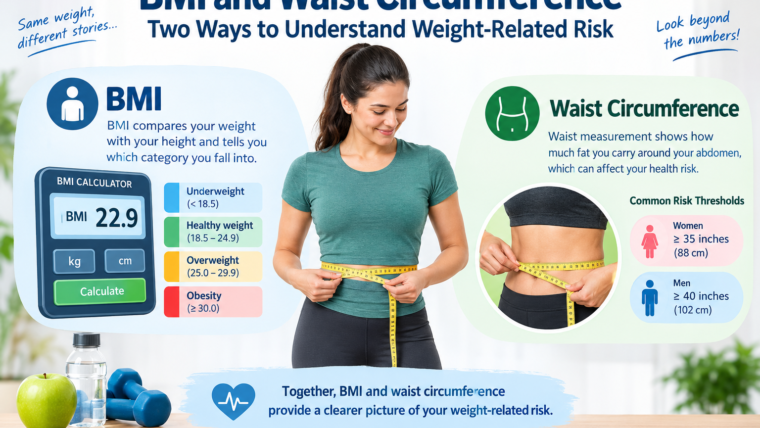

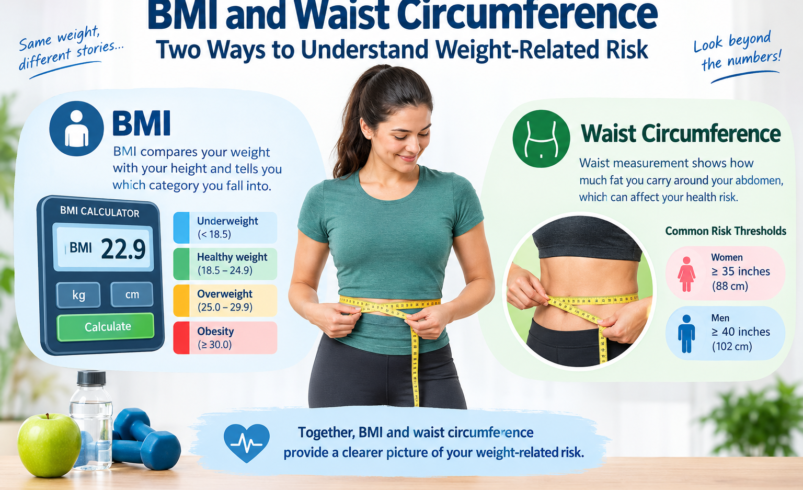

BMI and Waist Circumference: Two Ways to Understand Weight-Related Risk
If you are trying to understand whether your weight may be affecting your health, a BMI calculator can give you a useful starting point. Body mass index, commonly called BMI, compares your weight with your height and places the result into a standard BMI category. However, BMI does not show where your body stores fat. That is why waist circumference can provide useful additional information, particularly about fat carried around the abdomen.
Looking at both your BMI and waist measurement can give you a broader picture than relying on either number alone. A person can have a normal BMI while carrying more abdominal fat, while someone with a higher BMI may have a large amount of muscle rather than excess body fat.
What Is BMI?
BMI, or body mass index, is a numerical measure calculated from your weight and height. It is commonly used as a screening measure to classify adult weight status.
For adults, the basic BMI formula is:
BMI = weight in kilograms ÷ height in meters²
If you use pounds and inches, the formula is:
BMI = (weight in pounds × 703) ÷ height in inches²
You can work out BMI manually, but using a BMI calculator is faster and reduces the chance of making a calculation error.
BMI is not a direct measurement of body fat. It does not distinguish between fat, muscle, and bone mass, so the number needs to be interpreted in context. For example, a person with substantial muscle mass may have a higher BMI without having a high level of body fat.
BMI Scale and Adult BMI Categories
For adults aged 20 and older, standard BMI categories are generally interpreted as follows:
| BMI | Category |
|---|---|
| Below 18.5 | Underweight |
| 18.5 to 24.9 | Healthy weight |
| 25.0 to 29.9 | Overweight |
| 30.0 or higher | Obesity |
These categories are useful for screening, but they should not be treated as a diagnosis by themselves. Your medical history, physical activity, muscle mass, laboratory results, and other health factors can also affect how your BMI should be understood.
A BMI of 25 marks the beginning of the standard adult overweight category. A BMI in the healthy range does not automatically mean that a person has low health risk, just as a BMI outside that range does not tell the complete story.
For children and teenagers, adult BMI categories should not be used in the same way. BMI for children and teens is interpreted according to age and sex using percentiles and growth charts.
How Does a BMI Calculator Work?
A BMI calculator normally asks for two basic measurements:
- Your height
- Your weight
You may be able to enter these measurements using metric units such as kilograms and centimeters or imperial units such as pounds, feet, and inches.
Once the measurements are entered, the calculator applies the BMI formula and provides a BMI value. It can then compare that value with standard adult BMI categories.
For example, if your height is 1.75 meters and your weight is 70 kilograms:
BMI = 70 ÷ (1.75 × 1.75) = approximately 22.9
That result falls within the standard healthy-weight BMI range for adults.
A calculator can answer questions such as “what is my BMI?”, “what’s my BMI?”, or “my BMI” by turning your height and weight into a single number that is easier to interpret.
BMI and Waist Circumference: Why Use Both?
BMI and waist measurement tell you different things.
BMI looks at weight in relation to height. Waist circumference provides information about the amount of fat carried around the abdomen. This distinction matters because abdominal fat, particularly visceral fat stored deeper inside the abdomen, is associated with several health risks.
For this reason, a person with a normal BMI can still have a larger waist circumference and potentially increased health risk related to abdominal fat. Conversely, someone with a higher BMI may need additional assessment to understand how much of that weight comes from muscle versus fat.
This is why BMI and waist circumference are better viewed as complementary measurements rather than competing measurements.
What Is Waist Circumference?
Waist circumference is the distance around your waist measured with a flexible tape measure. It is sometimes described as waist size, waistline measurement, or abdominal girth.
The measurement can provide an indication of whether you carry a greater amount of fat around your abdomen. A larger waist circumference is associated with increased risk for conditions such as type 2 diabetes and cardiovascular disease.
There is no single waist size that defines perfect health for every person. Factors such as sex, ethnicity, pregnancy status, age, and overall health can affect how a measurement should be interpreted.
Common U.S. clinical guidance uses 35 inches (88 cm) for women and 40 inches (102 cm) for men as important risk thresholds. NIDDK notes that women with a waist size of 35 inches or more and men with a waist size of 40 inches or more may have a higher risk of obesity-related health problems.
These values should be treated as risk markers rather than a definition of whether someone is healthy or unhealthy.
How to Measure Your Waist
Knowing how to measure your waist correctly is important because small differences in measurement technique can affect the result.
A practical approach is:
- Stand upright with your feet together and your abdomen relaxed.
- Place a flexible measuring tape around your waist.
- Keep the tape horizontal and make sure it is snug without pressing into your skin.
- Take the measurement after a normal breath out.
- Record the measurement in inches or centimeters.
The exact measurement site can vary between guidelines. The American Heart Association describes waist circumference as the distance around the natural waist near the iliac crest, or hip bone.
For consistency, use the same measurement method each time if you are tracking changes in your waist size.
Waist Measurement for Women and Men
Waist circumference is interpreted differently in some clinical settings for women and men.
For the commonly used U.S. thresholds:
- Women: 35 inches (88 cm) or more may indicate increased health risk.
- Men: 40 inches (102 cm) or more may indicate increased health risk.
These thresholds are useful reference points, but they are not an ideal waist size calculator or a guarantee of health. They are risk markers used alongside other information.
You may see different waist circumference charts or recommendations from different countries and organizations. Some populations can have different levels of metabolic risk at the same BMI or waist measurement, so local clinical guidance may be more appropriate for certain groups.
BMI Calculator With Waist Measurement
A BMI calculator with waist measurement can combine two useful pieces of information: your BMI and your waist circumference.
For example, consider two people who have the same BMI. Their waist measurements may be different, meaning they may carry different amounts of fat around the abdomen. BMI alone would not reveal that difference.
This is one reason health professionals may consider both BMI and waist size when assessing weight-related risk.
However, a BMI calculator waist feature should not be interpreted as a medical diagnosis. BMI and waist circumference are screening measurements, and a complete health assessment may include blood pressure, blood glucose, cholesterol, medical history, physical examination, and other factors.
Is a Healthy BMI the Same for Everyone?
Not necessarily.
For adults, the standard healthy BMI range is 18.5 to 24.9. However, BMI has limitations and does not directly measure body fat. Age, muscle mass, body composition, ethnicity, and other factors can affect how useful BMI is for an individual.
For example, older adults can experience changes in muscle and body fat distribution that are not fully reflected by BMI. Some people of Asian ancestry may also have higher health risks associated with abdominal fat at lower BMI levels than the standard thresholds suggest.
Therefore, asking “what is a healthy BMI?” is useful, but the answer should be considered alongside the person’s broader health profile.
BMI vs. Waist Circumference
| Measurement | What it tells you | Main limitation |
|---|---|---|
| BMI | Weight relative to height | Does not show where fat is stored |
| Waist circumference | Gives an indication of abdominal fat distribution | Does not measure total body fat directly |
| Both together | Provides more context about weight-related risk | Still cannot provide a complete health assessment |
The main advantage of using both is that they measure different characteristics. BMI provides a height-to-weight relationship, while waist circumference gives additional information about abdominal fat distribution.
Does BMI Measure Body Fat?
No. BMI is calculated using height and weight and does not directly measure body fat percentage.
Someone with a high amount of muscle may have a higher BMI because muscle contributes to body weight. On the other hand, a person can have a BMI within the standard healthy range while carrying a relatively high amount of abdominal fat.
This is one reason BMI should be viewed as a screening measure rather than a complete measurement of body composition.
If a more detailed assessment is needed, a healthcare professional can consider other measurements and clinical information.
What Does Your BMI and Waist Size Mean Together?
Looking at the two measurements together can provide more context.
For example:
Normal BMI + larger waist:
BMI may appear within the healthy range, but a larger waist can indicate greater abdominal fat and may warrant attention to other risk factors.
Higher BMI + larger waist:
Both measurements may point toward a higher level of weight-related risk, although additional factors are still important.
Higher BMI + smaller waist:
The BMI may be influenced partly by muscle mass or body composition, so additional assessment may help explain the result.
Lower BMI + smaller waist:
These measurements may fall within commonly used healthy ranges, but they still do not provide a complete picture of overall health.
The purpose of using both measurements is not to produce a single “perfect” number. It is to understand different aspects of body size and weight-related risk.
How Often Should You Check BMI and Waist Measurement?
There is no universal schedule that everyone needs to follow. If you are monitoring changes in your weight or waist size, consistency is more useful than checking repeatedly throughout the day.
You can use a BMI calculator when your height and weight change significantly or when you want to understand your current BMI category. Waist circumference can also be tracked periodically using the same measurement technique.
If your measurements are changing unexpectedly, or you are concerned about your weight, waist size, blood pressure, blood sugar, or other health indicators, discuss the results with a healthcare professional.
Frequently Asked Questions
What is BMI?
BMI stands for body mass index. It is a calculated measure based on weight and height that is commonly used to screen for adult weight categories.
How do I calculate BMI?
For adults using metric measurements, divide your weight in kilograms by your height in meters squared. You can also enter your height and weight into a BMI calculator to get the result automatically.
What is a healthy BMI?
For adults, a BMI from 18.5 to 24.9 is generally classified as healthy weight under standard BMI categories. BMI is a screening measure and should be considered alongside other health information.
Is BMI 25 healthy?
A BMI of 25 falls at the beginning of the standard adult overweight category. However, BMI alone does not determine an individual’s overall health or body composition.
How do I measure waist circumference?
Use a flexible tape measure around your natural waist, keeping the tape level and snug without compressing the skin. Follow a consistent measurement method when tracking changes.
What is a healthy waist size for women?
A commonly used U.S. clinical threshold is 35 inches (88 cm). A waist circumference at or above this level may be associated with increased risk of obesity-related health problems.
What is a healthy waist size for men?
A commonly used U.S. clinical threshold is 40 inches (102 cm). A measurement at or above this level may be associated with increased health risk.
Can I use BMI and waist circumference together?
Yes. They provide different information. BMI relates weight to height, while waist circumference provides information about abdominal fat distribution. Considering both can provide more context than using either measurement alone.
The Bottom Line
A BMI calculator is a convenient way to estimate your body mass index from your height and weight, while waist circumference provides another useful measurement related to abdominal fat distribution. Neither number tells the entire story on its own.
If you want to understand your weight-related health risk, start by checking your BMI and measuring your waist consistently. Then consider the results alongside factors such as age, body composition, medical history, physical activity, blood pressure, blood glucose, and cholesterol.
Most importantly, treat BMI and waist circumference as screening tools, not diagnoses. If you have concerns about your measurements or your health, a healthcare professional can help interpret them in the context of your individual circumstances.