
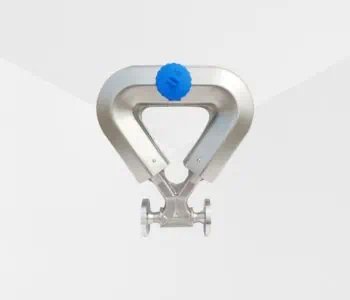

Accurate flow measurement is essential in many industrial processes, particularly where liquids or gases need to be measured with high precision. A Coriolis flow meter is a mass flow measurement instrument that determines the flow of a process medium by using the Coriolis effect.
Unlike velocity-based flow meters, a Coriolis meter measures mass flow directly. This makes it useful in processes where knowing the actual mass of material passing through a pipeline is more important than simply measuring its volume.
How Does a Coriolis Flow Meter Work?
The Coriolis flowmeter usually consists of one or several measuring tubes along which the process fluid flows. The measuring tubes are designed to vibrate at a definite frequency.
In the absence of flow, the tubes continue vibrating in a regular way. However, as soon as the fluid begins flowing in the tubes, the vibration and flow of the fluid generate Coriolis force, resulting in changes in vibration phase.
The changes are detected by sensors and processed by a transmitter to calculate the mass flow rate of the fluid.
However, based on the same principle, additional process variables can be determined.
Why Use Mass Flow Measurement?
However, in many industrial operations, there may be changes in volume because of changes in temperature, pressure or density of material. In such cases, mass flow measurement gives an accurate picture of the amount of material flowing.
This method is especially helpful in cases of batching, blending, dosing, measurement and process control applications.
Where Are Coriolis Flow Meters Used?
Coriolis technology can be considered for a wide range of industrial applications involving liquids and gases. Typical areas include:
- Chemical processing
- Oil and gas
- Food and beverage
- Pharmaceutical manufacturing
- Petrochemical processes
- Fuel measurement
- Batch processing
- Dosing and blending systems
The actual suitability depends on the characteristics of the process medium and the operating conditions.
Advantages of Coriolis Flow Meters
The most significant advantage of the Coriolis flow meter is that it directly measures mass flow. It is also capable of offering very accurate measurement when properly selected and installed.
As the measurement is not based mainly on a rotor, no turbine blades or any other rotating parts need to be used in order to measure.
Based on its design, the Coriolis meter is capable of delivering even more process data.
What Should Be Considered During Selection?
Choosing a Coriolis flow meter requires an understanding of the process rather than simply matching the meter to the pipeline diameter.
Important factors can include:
- Type of fluid
- Liquid or gas service
- Minimum and maximum flow
- Operating pressure
- Process temperature
- Fluid density and viscosity
- Required accuracy
- Pipe size
- Installation conditions
- Output and communication requirements
- Material compatibility
The application should also be evaluated for conditions such as entrained gas, changing process density, or significant pressure and temperature variations.
Industrial Applications
Coriolis flow meters become highly useful in cases when accurate material measurement is directly linked to the quality of the product or efficiency of the process. A process of manufacture might, for instance, require material measurement by weight in order to batch the material, and a chemical process might require controlled dosing of various materials.
Here, direct mass measurement could prove useful for process uniformity and accuracy of data provided.
Final Thoughts
The Coriolis flowmeter uses the Coriolis force to measure mass flow due to the changes induced in the vibrating measurement tubes. Direct mass flow measurement capability is one reason why the meter is well suited for industrial applications.
Ready to transform your operations with precision metering? Reach out today to learn how our advanced solutions from top-tier manufacturers and trusted suppliers can help you unlock unparalleled efficiency in your industrial processes.