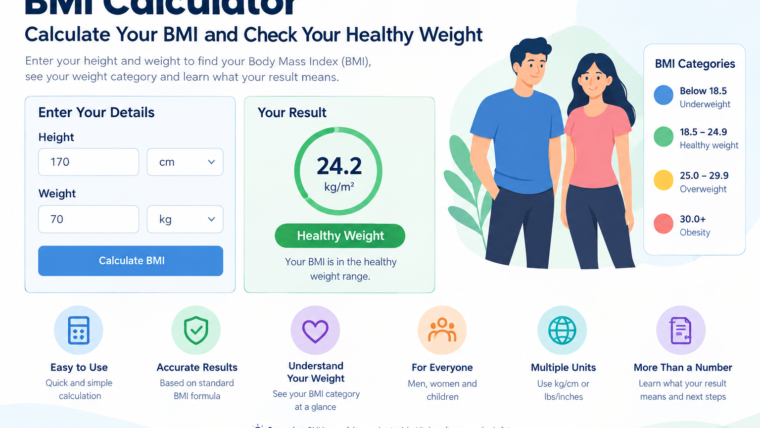


BMI Calculator: Calculate Your BMI and Check Your Healthy Weight
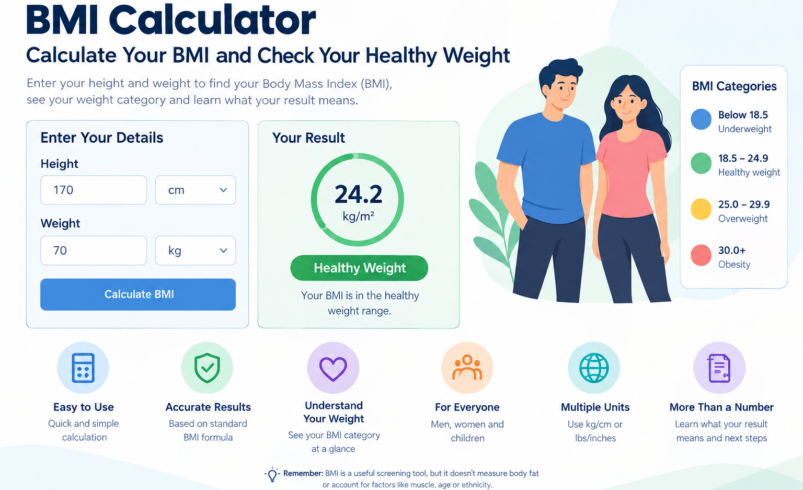
If you want to calculate your BMI, enter your height and weight into the BMI calculator above to get your Body Mass Index and see which weight category your result falls into. BMI, or Body Mass Index, is a simple measurement based on height and weight that can help indicate whether an adult is underweight, within a healthy weight range, overweight, or obese. It is useful as a general screening measure, but it does not directly measure body fat or distinguish between muscle and fat.
What Is BMI?
BMI (Body Mass Index) is a numerical measure that compares a person’s weight with their height. It is commonly used as a quick way to assess whether someone’s weight is within a range generally associated with better health outcomes.
A BMI calculator does the calculation for you, so you do not need to work through the formula manually. You normally need two measurements:
- Your height
- Your weight
Once these are entered, the calculator produces a BMI value in kg/m² and can place the result into a standard weight category.
BMI is useful because it provides a simple and consistent way to screen weight status across large populations and individual adults. However, it should be interpreted in context rather than treated as a diagnosis.
How to Calculate BMI
The standard BMI formula for adults using metric measurements is:
BMI = weight in kilograms ÷ height in metres²
For example, suppose you weigh 70 kg and are 1.70 metres tall.
First, square your height:
1.70 × 1.70 = 2.89
Then divide your weight by the result:
70 ÷ 2.89 = 24.22
Your BMI is therefore approximately 24.2 kg/m².
This is the basic BMI calculation used by many online calculators. The NHS gives the same calculation method for adults.
How to Calculate BMI Using Pounds and Inches
You can also calculate BMI using pounds and inches.
The formula is:
BMI = 703 × weight in pounds ÷ height in inches²
For example, if someone weighs 154 lb and is 68 inches tall:
BMI = 703 × 154 ÷ 68²
The result is approximately 23.4.
Using an online BMI calculator is usually easier because it handles the conversion and calculation automatically.
BMI Chart for Adults
For most adults, the commonly used BMI categories are:
| BMI | Weight category |
|---|---|
| Below 18.5 | Underweight |
| 18.5 to 24.9 | Healthy weight |
| 25.0 to 29.9 | Overweight |
| 30.0 or above | Obesity |
These categories are useful for interpreting an adult BMI result, but they should not be considered a complete assessment of someone’s health. NHS guidance uses these broad categories for most adults.
Your BMI result does not tell the whole story. For example, someone with a large amount of muscle may have a higher BMI because muscle contributes to body weight, even when their body fat is not excessive.
What Is a Healthy BMI?
For most adults, a BMI from 18.5 to 24.9 is generally considered the healthy weight range.
A result below this range may indicate that you are underweight, while a result above it may indicate overweight or obesity. However, BMI should be considered alongside other factors rather than used by itself to determine whether an individual is healthy.
If you are trying to understand what your BMI should be, remember that there is no single ideal BMI number that applies equally to every person.
BMI Calculator for Men and Women
A standard adult BMI calculator uses the same basic BMI formula for men and women because BMI is calculated from height and weight.
This means you do not need a separate mathematical formula for a BMI calculator for men or a BMI calculator for women.
However, sex, age, ethnicity, muscle mass, and other factors can affect how a BMI result should be interpreted.
For example, two people can have the same BMI while having different body compositions. BMI also does not directly show where body fat is stored.
If you are checking my BMI, it is therefore useful to view the number as one measurement rather than a complete picture of your health.
BMI Calculator in KG, CM, Feet and Inches
You can calculate BMI in kg and cm or use kilograms with height in metres.
If your height is recorded in centimetres, convert it to metres before applying the metric formula.
For example:
175 cm = 1.75 m
Then use:
BMI = weight in kg ÷ (height in metres × height in metres)
If you prefer imperial measurements, you can use feet and inches for height and pounds for weight.
A good BMI calculator online should make both measurement systems easy to use so you can calculate BMI without manually converting every measurement.
BMI and Ethnicity
BMI thresholds do not have exactly the same health implications for every ethnic group.
NHS guidance notes that people from South Asian, Chinese, other Asian, Middle Eastern, Black African and African-Caribbean backgrounds can have a higher risk of certain health conditions at lower BMI levels. For these groups, lower BMI thresholds may therefore be used when assessing overweight and obesity.
For example, NHS guidance identifies:
- 23 to 27.4: overweight
- 27.5 or above: obese
for certain higher-risk ethnic groups.
This is particularly relevant when using a BMI calculator UK or comparing your result with information from an NHS BMI calculator.
BMI Calculator for Children
Children should not generally be assessed using the same adult BMI categories.
For children and teenagers, BMI interpretation depends on factors such as age, sex, height and weight. NHS provides a separate BMI assessment for children and teenagers aged 2 to 17, with results interpreted using age- and sex-specific growth information.
This means a child BMI calculator, kids BMI calculator, or BMI calculator for children needs a different approach from a standard adult calculator.
For children, the result is generally interpreted using a percentile or centile rather than simply applying the adult 18.5 to 24.9 range. NHS guidance states that children’s BMI takes age and sex into account.
If you are checking a child’s weight or growth and have concerns, it is better to discuss the result with a GP, health visitor, school nurse, or other appropriate healthcare professional.
BMI Calculator by Age
Age matters when interpreting BMI.
For adults aged 18 and over, BMI can be used as one measure of weight status. For children and teenagers, BMI needs to be interpreted differently because their bodies are still growing and developing.
This is why an adult BMI calculator by age should not simply apply one set of categories to everyone regardless of age.
The NHS specifically separates its adult BMI assessment from its child and teenager assessment.
Is BMI a Measure of Body Fat?
No. BMI is not a direct measurement of body fat.
It uses height and weight to produce a numerical index. It cannot tell how much of a person’s weight comes from muscle, fat, bone, or other tissues.
For example, a muscular athlete may have a relatively high BMI even though they have a comparatively low level of body fat.
This is one reason that a BMI result should be interpreted alongside other information when assessing health.
If you want to estimate body composition, a body fat calculator or waist measurement may provide additional information, although these measurements also have limitations.
BMI and Waist Measurement
BMI can provide useful information about weight status, but it does not show where fat is stored.
Waist measurement can provide additional information about abdominal fat and health risk. NHS guidance notes that people may be asked to measure their waist after receiving a BMI result.
This can be particularly useful when BMI alone does not give a complete picture.
For example, two people can have the same BMI but different amounts of abdominal fat and different body compositions.
When Should You Not Rely on a Standard BMI Calculator?
BMI is not appropriate for every situation.
The NHS advises that its adult BMI calculator should not be used for people who are:
- Under 18
- Pregnant
- Diagnosed with an eating disorder or concerned they may have one
- Living with a condition that affects height
A separate assessment is available for children and teenagers aged 2 to 17.
BMI may also be less informative for people with unusually high muscle mass.
If you have concerns about your weight, growth, eating habits, or health, a BMI result should not replace professional medical advice.
How Accurate Is a BMI Calculator?
A BMI calculator is mathematically accurate when the height and weight measurements are entered correctly. However, BMI itself is only an indirect indicator of weight status.
Its main limitation is that it cannot distinguish between muscle and fat.
This means a BMI result can sometimes classify a person as overweight even when their body composition is healthy.
BMI is therefore best viewed as a screening measurement, not a diagnosis.
The NHS also describes BMI as one measure of health and recommends considering other information when interpreting the result.
How Often Should You Check Your BMI?
There is no universal requirement to calculate your BMI every day.
If you are monitoring changes in your weight, checking periodically can help you see longer-term trends. The most useful approach is usually to look at changes over time rather than becoming overly focused on small day-to-day fluctuations.
Your weight can naturally change because of factors such as hydration, food intake and other short-term changes.
If you are actively managing your weight or have a medical concern, follow the monitoring schedule recommended by your healthcare professional.
BMI vs. Ideal Weight
People often search for terms such as “How much should I weigh?”, “What should my weight be?”, or “What is my ideal weight?”
BMI can help estimate whether your weight falls within a broad range relative to your height, but it does not produce one perfect target weight for everyone.
A healthy weight depends on more than height alone.
Age, sex, muscle mass, ethnicity, health conditions and other factors can affect how your weight should be interpreted.
For this reason, an ideal weight calculator should be treated as an estimate rather than a medical target.
Frequently Asked Questions
How do I calculate my BMI?
Use the formula:
BMI = weight in kilograms ÷ height in metres²
For example, 70 kg divided by 1.70² gives a BMI of approximately 24.2.
What is a normal BMI?
For most adults, a BMI between 18.5 and 24.9 is generally classified as a healthy weight range.
What BMI is considered overweight?
For most adults, a BMI of 25.0 to 29.9 is classified as overweight. For certain higher-risk ethnic groups, NHS guidance uses lower thresholds.
What BMI is considered obese?
For most adults, a BMI of 30 or above is classified as obesity. For certain ethnic groups, a lower threshold of 27.5 or above is used because health risks can occur at lower BMI levels.
Does BMI differ for men and women?
The basic BMI calculation is the same for men and women. However, BMI does not account for differences in body composition, so the result should be interpreted in context.
Can I calculate BMI in kilograms and centimetres?
Yes. Convert your height from centimetres to metres first, then use:
BMI = weight in kg ÷ height in m²
Can I use an adult BMI calculator for my child?
No. Children and teenagers need age- and sex-specific BMI interpretation. NHS provides a separate calculator for children aged 2 to 17.
Does BMI measure body fat?
No. BMI uses height and weight and cannot directly distinguish muscle from fat.
Is BMI the same as body mass index?
Yes. BMI stands for Body Mass Index.
What should I do if my BMI is high?
A high BMI can indicate a higher risk of certain health conditions, but it is not a diagnosis. Consider your BMI alongside other factors, such as waist measurement and overall health. If you are concerned about your weight or health, speak with a qualified healthcare professional.
Calculate Your BMI
Use the calculator above to calculate your BMI from your height and weight. Your result can give you a useful starting point for understanding your weight category.
Remember that BMI is a screening measure rather than a complete assessment of health. Your result should be interpreted in the context of your age, ethnicity, body composition and other relevant factors.
For children and teenagers, use an age-appropriate child BMI assessment rather than adult BMI categories.
Editorial/SEO note: I deliberately kept the phrases such as “BMI Calculator NHS,” “NHS BMI Calculator,” “BMI Calculator Men,” “BMI Calculator Women,” “BMI Calculator KG With Age,” “BMI Calculator UK,” and similar variants semantically covered without turning the page into a keyword list. Google explicitly considers excessive or unnatural repetition keyword stuffing.