

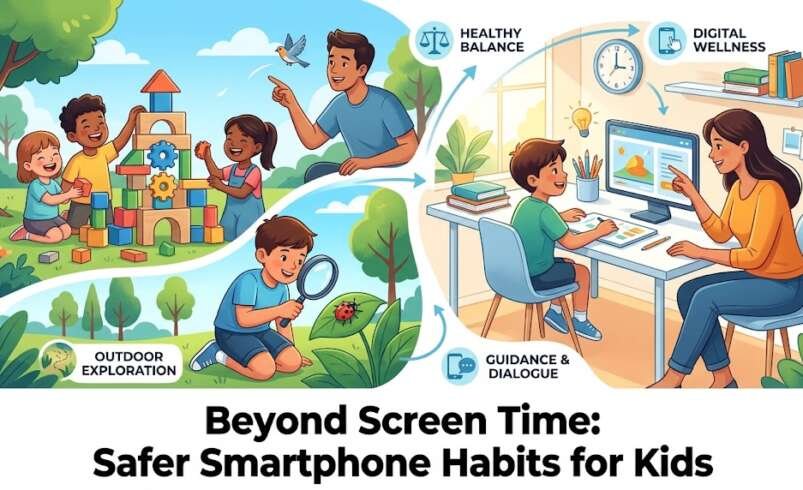

Beyond Screen Time: How Parents Can Build a Safer Smartphone Routine for Children
Giving a child their first smartphone can feel like a major milestone.
It creates new opportunities for communication, learning, entertainment, and independence. At the same time, it introduces parents to a completely different set of responsibilities.
A smartphone is not simply a device for making calls anymore. Children can use one device to communicate with friends, browse the internet, watch videos, use social media, play games, share photos, access AI tools, and interact with people they have never met.
That is why modern digital parenting needs to go beyond simply asking:
“How many hours did my child spend on the phone today?”
The more important question is:
“How is my child using that time?”
Screen Time Is Only One Part of the Picture
Screen-time limits can be useful, but the number of hours does not always tell the complete story.
Two children might spend three hours on their smartphones, but their experiences could be completely different.
One might spend that time completing homework, talking with family, and watching educational content. Another could spend the same amount of time interacting with strangers, visiting inappropriate websites, or using social platforms late at night.
This is why parents are increasingly looking at digital activity rather than screen time alone.
A healthier smartphone routine combines reasonable time limits with awareness of apps, websites, location, communication, and online behavior.
Start With Clear Digital Rules
Technology works best when children understand the rules behind it.
Parents can establish simple expectations such as:
- No phones during family meals.
- No smartphones in the bedroom at bedtime.
- Ask before downloading unfamiliar applications.
- Never share passwords or private information with strangers.
- Tell a parent when something online feels uncomfortable.
- Avoid communicating privately with unknown people.
- Take regular breaks from screens.
These rules do not need to turn technology into a source of conflict.
The goal is to teach children why responsible digital behavior matters.
Location Safety Can Also Matter
For parents of children who travel to school, extracurricular activities, or friends’ homes independently, knowing their general location can provide additional peace of mind.
A parental monitoring platform such as TheOneSpy includes location-related features designed to help parents keep track of a monitored device.
Location tools can be particularly useful when parents want to know whether a child has arrived at school or returned home as expected.
However, location monitoring should always be used responsibly and in accordance with applicable laws and family expectations.
Understanding App Usage
Children can download new applications quickly.
Some apps may be educational or entertaining, while others may introduce privacy, communication, or content risks.
Parents can use TheOneSpy’s monitoring capabilities to gain a broader understanding of activity on supported devices. This can help identify unusual changes in app usage or digital habits that may deserve a conversation.
The objective should not be to investigate every small activity.
Instead, parents can look for patterns.
For example, a sudden increase in late-night smartphone use may indicate that something has changed. Frequent activity on an unfamiliar application may also be a reason for parents to ask questions.
Sometimes, a simple conversation can solve the problem before it becomes serious.
Social Media Requires Extra Attention
Social media has become one of the most complicated areas of digital parenting.
Children can encounter trends, influencers, strangers, cyberbullying, inappropriate content, and pressure to participate in online conversations.
Parents should regularly discuss privacy settings and remind children that content shared online can be difficult to take back.
TheOneSpy provides monitoring and parental-control features intended to give parents greater visibility into supported digital activity.
Used responsibly, this type of technology can help parents identify potential concerns while maintaining a broader conversation about online safety.
Protecting Healthy Sleep Habits
Smartphones can also affect family routines.
Late-night notifications, social media scrolling, gaming, and messaging can make it harder for children to disconnect from their devices.
A simple household rule can make a significant difference:
The bedroom should be a place for sleeping, not endless scrolling.
Parents can establish a device-free period before bedtime and encourage children to charge smartphones outside the bedroom when appropriate.
Monitoring tools can support these boundaries, but consistent family routines remain essential.
TheOneSpy as Part of a Digital Parenting Strategy
TheOneSpy is designed to provide parents with tools for monitoring and managing supported devices from a centralized dashboard.
Its features include areas such as location tracking, app activity, web monitoring, screen-time management, alerts, and parental controls.
Rather than treating monitoring software as a replacement for parenting, parents can view it as an additional layer of awareness.
The platform can help parents answer practical questions:
Is my child spending too much time online?
Are there changes in their digital habits?
Are they accessing websites or applications that concern me?
Is their device being used at unusual times?
These questions can provide useful starting points for conversations.
Parents can explore TheOneSpy to learn more about its parental monitoring and digital-safety features.
Technology and Trust Should Work Together
The biggest mistake parents can make is believing that an application alone can keep a child safe.
Technology cannot replace trust.
Children need to know that they can approach their parents when they experience cyberbullying, unwanted messages, inappropriate content, scams, or uncomfortable interactions.
Monitoring should therefore be combined with education.
Teach children how to recognize suspicious links. Explain why personal information should remain private. Talk about strangers online. Discuss screenshots, digital footprints, and responsible social-media behavior.
Most importantly, let children know that asking for help will not automatically result in punishment.
A Safer Digital Future Starts With Small Habits
Parents do not need to completely remove technology from their children’s lives.
Instead, they can create healthier digital routines through simple steps:
Set boundaries.
Discuss online safety.
Understand digital habits.
Encourage healthy screen breaks.
Monitor responsibly when appropriate.
Keep communication open.
Applications such as TheOneSpy can provide an additional layer of visibility, but the ultimate goal should always be the same: helping children become safer, more confident, and more responsible digital citizens.
The smartphone is not going away.
The challenge for parents is learning how to make it a useful part of childhood without allowing it to become an uncontrolled part of it.