
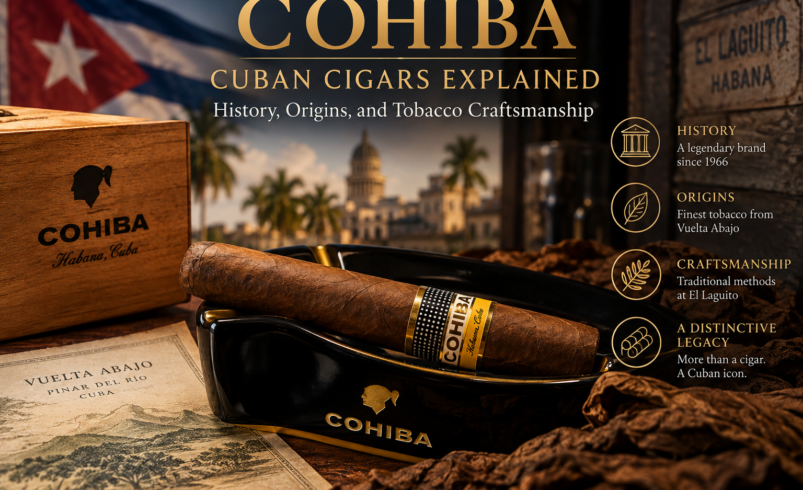

Cohiba is one of the most recognizable names in Cuban cigar production. The brand has a history dating back to 1966 and is closely associated with carefully selected Cuban tobacco, traditional hand-rolling and the historic El Laguito factory in Havana.
While Cohiba is often discussed as though it represents a single cigar, the brand actually includes several lines and numerous formats. The Línea Clásica, Línea 1492, Maduro 5 and Behike collections have different characteristics, sizes and tobacco combinations.
Understanding Cuban Cohiba cigars therefore begins with their history and tobacco origins before looking at the craftsmanship and production methods that distinguish the brand.
The Origins of Cohiba
Cohiba was created in Cuba in 1966. Habanos states that the cigars were initially reserved for official gifts to Cuban and foreign government figures and were also associated with Fidel Castro. The brand was introduced to international markets in 1982.
The name itself has a much older connection with tobacco. Habanos explains that “Cohiba” comes from a Taíno word used for rolled tobacco leaves smoked by Indigenous people in Cuba. Christopher Columbus encountered this form of tobacco use when he arrived in Cuba in 1492.
This connection between the name and early Cuban tobacco culture became part of the identity of the modern brand.
El Laguito and Cohiba Production
One of the most important places in Cohiba’s history is El Laguito, a historic factory in Havana.
Habanos identifies El Laguito as the traditional Cohiba factory. The facility was already producing cigars for Cuban personalities and leaders before Cohiba was formally established as a brand in 1966.
Today, El Laguito remains closely associated with the production of premium Cohiba Habanos. The factory contains different stages of cigar production, including preparation of tobacco, rolling and final finishing.
The factory’s importance is therefore not simply historical. It forms part of the production tradition behind the brand.
Where Cohiba Tobacco Comes From
Tobacco origin is one of the defining characteristics of Cuban Cohiba.
Habanos states that Cohiba uses exceptionally selected leaves from the Vuelta Abajo region of Pinar del Río, particularly from the areas around San Juan y Martínez and San Luis. The company describes these leaves as the “selection of the selection” from the region’s best growing areas.
Vuelta Abajo is one of Cuba’s most important tobacco-growing regions. Habanos describes it as the principal source of tobacco for premium Habanos and notes that the region produces the different types of leaves required for wrappers, binders and fillers.
The growing environment, agricultural practices and careful selection of leaves all contribute to the raw material used in Cohiba production.
Tobacco Selection and Craftsmanship
Producing a premium cigar involves considerably more than simply rolling tobacco leaves together.
The leaves must undergo several stages of preparation before reaching the rolling room. These processes include curing, fermentation, aging, sorting and preparation for cigar construction.
Habanos describes premium Cohiba cigars as totally handmade with long filler. Long filler means that the central tobacco consists of full-length leaves rather than chopped tobacco pieces.
The traditional cigar consists of three principal components:
- Filler: The tobacco forming the centre of the cigar and contributing substantially to its flavour and combustion.
- Binder: The leaf surrounding the filler and helping hold the internal tobacco together.
- Wrapper: The outer leaf that provides the finished appearance and contributes to aroma and flavour.
The roller’s skill is important because the leaves need to be arranged and rolled consistently to produce an appropriate draw and even combustion.
Cohiba’s Additional Fermentation
One of the most distinctive aspects of Cohiba’s tobacco processing is the additional fermentation applied to particular filler leaves.
Habanos states that seco and ligero, two of the three types of tobacco leaves used in Cohiba’s filler, undergo additional fermentation. Historical Habanos documentation describes this as a third fermentation carried out in barrels.
Habanos identifies this additional treatment as an important contributor to Cohiba’s characteristic aroma and flavour.
Fermentation should not be confused with simply aging a finished cigar. It is a tobacco-processing stage that takes place before the leaves are incorporated into the finished product.
This additional processing is one of the production characteristics that separates Cohiba from many other Habanos brands.
Cohiba’s Main Lines
Cohiba is a portfolio rather than a single cigar.
Línea Clásica
The Línea Clásica is the original Cohiba range. Habanos states that the line was developed between 1966 and 1989 and is associated with a medium-to-full flavour profile.
Formats associated with this line include the Lancero, Coronas Especiales, Robusto and Espléndidos.
Línea 1492
The Línea 1492 was introduced in 1992 to commemorate the 500th anniversary of Christopher Columbus’s arrival in Cuba. Habanos describes this line as medium in flavour.
The Siglo series became an important part of this collection.
Maduro 5
The Cohiba Maduro 5 line was introduced in 2007. Its defining feature is the mature wrapper leaf aged for five years using natural processes.
The line introduced three new vitolas and provided a different expression of Cohiba tobacco.
Behike
The Cohiba Behike line was introduced in 2010 and represents another distinct part of the brand’s portfolio. Habanos describes it as the most exclusive Cohiba line.
Behike cigars are distinguished by their specific tobacco selection and construction, so they should not simply be treated as larger versions of the Línea Clásica.
Cohiba Formats and Dimensions
One reason Cohiba offers such a varied experience is the range of available formats.
For example, the Cohiba Robusto measures approximately 124 mm × 50 ring gauge. The Siglo VI measures approximately 150 mm × 52 ring gauge, while other Cohiba vitolas are considerably longer or thinner.
Format affects the smoking experience in several ways.
Length influences the duration of a cigar, while ring gauge affects its diameter and the amount of tobacco contained within the cigar.
A larger cigar does not simply provide “more flavour.” Its proportions can change the balance between wrapper and filler, smoke volume and the way individual characteristics develop during the smoking session.
Cohiba’s Flavour Characteristics
Cohiba’s flavour is closely connected to its tobacco selection and processing.
Habanos specifically associates the additional fermentation of seco and ligero with the brand’s distinctive aroma and flavour.
Descriptions of Cohiba cigars can include characteristics such as:
- Cedar and other woody notes
- Earthy tobacco
- Roasted or toasted flavours
- Pepper
- Gentle spice
- Herbal characteristics
- Natural tobacco sweetness
The exact balance varies between lines and formats.
For example, a Línea Clásica cigar should not necessarily be expected to taste identical to a Siglo, Maduro 5 or Behike. Different tobacco combinations, wrappers, dimensions and aging can influence the final character.
Storage conditions can also affect the way a cigar performs and how its flavours are perceived.
The Role of the Torcedor
The Cuban cigar roller, or torcedor, is central to traditional handmade production.
Habanos describes the cigar-making workshop, or galera, as the heart of handmade cigar production. The craft involves techniques that have changed relatively little over many generations.
For premium Cohiba Habanos, the use of long filler and hand construction means that the roller plays an important role in the physical structure of the finished cigar.
The tobacco needs to be positioned correctly, the bunch must be formed appropriately and the wrapper must be applied carefully to produce a finished cigar with suitable appearance and draw.
Why Cuban Cohiba Is Distinctive
Several characteristics come together to define the traditional Cuban Cohiba identity.
History: The brand was established in 1966 and became internationally available in 1982.
Tobacco: Premium Cohiba Habanos use highly selected tobacco from Vuelta Abajo, particularly San Juan y Martínez and San Luis.
Fermentation: Seco and ligero undergo additional fermentation as part of Cohiba’s distinctive tobacco preparation.
Craftsmanship: Premium Cohiba Habanos are made totally by hand with long filler.
Production: El Laguito in Havana has a longstanding connection with Cohiba manufacturing.
Variety: The brand includes several distinct lines and numerous formats rather than one standardized cigar.
Final Thoughts
The brand’s origins date to 1966, while its international history began in 1982. Its premium Habanos are associated with selected tobacco from Vuelta Abajo, particularly San Juan y Martínez and San Luis, and with the additional fermentation of seco and ligero leaves.
The connection with El Laguito and the use of traditional handmade, long-filler construction further distinguish the brand’s premium Habanos.
Understanding these elements provides useful context for the different Cohiba lines, from the original Línea Clásica to Línea 1492, Maduro 5 and Behike. Rather than treating Cohiba as a single flavour or format, it is more accurate to view it as a diverse portfolio built around a distinctive Cuban tobacco and production tradition.
As with all tobacco products, cigar smoking carries significant health risks, including exposure to harmful substances and the potential for nicotine dependence.