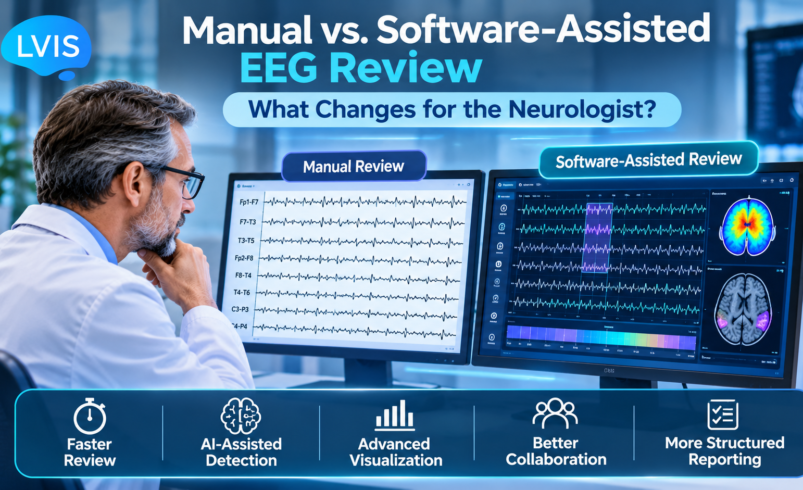

Electroencephalography (EEG) interpretation requires neurologists to examine complex electrical brain activity, identify clinically significant patterns, and distinguish abnormalities from artifacts. Traditional manual review relies heavily on clinical expertise and systematic examination of individual recordings, while modern EEG review software introduces digital navigation, automated analytical tools, and enhanced visualization capabilities. These technologies can help neurologists manage increasingly complex datasets and lengthy recordings. However, software-assisted workflows remain complementary to clinical expertise rather than a replacement for professional interpretation.
How EEG Review Software Changes Traditional EEG Interpretation
Manual EEG interpretation involves reviewing waveforms, identifying abnormal electrical activity, and evaluating findings alongside a patient’s clinical history. Although this approach remains fundamental to neurological diagnosis, lengthy recordings can place considerable demands on clinicians’ time and attention. Advanced EEG review software can support this process through digital signal visualization, event annotations, configurable review settings, and analytical capabilities. These features can help neurologists organize information and focus their attention on clinically relevant findings.
Understanding Traditional Manual EEG Review
Traditional EEG review involves examining recorded electrical brain activity to identify normal background rhythms, epileptiform discharges, seizures, slowing, and other clinically relevant patterns. Neurologists assess waveform morphology, frequency, amplitude, distribution, and temporal relationships throughout the recording. They must also distinguish genuine neurological activity from artifacts caused by muscle movement, eye movements, electrode issues, or electrical interference.
Although manual interpretation provides detailed clinical insight, reviewing prolonged recordings can be time-consuming, particularly in epilepsy monitoring units and intensive care environments.
Understanding Software-Assisted EEG Review
Software-assisted review combines conventional waveform interpretation with digital analytical capabilities designed to support clinical workflows. Depending on the platform, these capabilities may include automated event detection, quantitative EEG trends, advanced visualization, and configurable review tools.
Modern EEG analysis software can help neurologists identify sections of recordings that warrant closer examination. Rather than replacing conventional interpretation, these tools provide additional information that clinicians can evaluate alongside raw EEG signals, patient history, and clinical observations.
Manual vs. Software-Assisted EEG Review
| Feature | Manual EEG Review | Software-Assisted EEG Review |
|---|---|---|
| Waveform interpretation | Clinician-led visual examination | Clinician-led review supported by digital tools |
| Event identification | Primarily manual detection | Automated detection with clinical verification |
| Data navigation | Sequential or manually selected review | Advanced navigation and event prioritization |
| Long-duration recordings | Can require substantial review time | Analytical tools may streamline navigation |
| Pattern recognition | Dependent on clinical expertise | Clinical expertise supported by algorithms |
| Collaboration | Dependent on existing infrastructure | May support remote and shared review |
| Clinical interpretation | Neurologist-led | Neurologist-led |
The fundamental difference is how information is organized, presented, and analyzed rather than who makes the final clinical interpretation.
What Changes for the Neurologist?
1. More Efficient Navigation of Lengthy Recordings
Continuous and ambulatory EEG studies can generate substantial amounts of neurological data. Reviewing these recordings requires sustained attention and systematic evaluation of potentially significant events. Software-assisted navigation can help clinicians locate marked events, examine changes in electrical activity, and access relevant recording segments more efficiently.
These capabilities may reduce repetitive navigation tasks while allowing neurologists to dedicate more attention to detailed clinical interpretation.
2. AI-Assisted Seizure and Spike Detection
Artificial intelligence and automated signal processing technologies can assist in identifying potential seizures and epileptiform discharges. These tools analyze recorded signals and highlight patterns that may require further investigation. Neurologists can then examine the corresponding waveforms to determine their clinical significance.
Automated detection systems can produce false-positive and false-negative findings. Consequently, clinicians must evaluate algorithm-generated results within the context of the complete recording and relevant patient information.
3. Enhanced Quantitative EEG Visualization
Quantitative EEG tools transform recorded electrical activity into visual representations that can help clinicians examine changes over time. Frequency-power displays, spectrograms, and other analytical trends may provide additional perspectives when reviewing prolonged recordings.
These visualizations can support the identification of evolving neurological patterns, particularly during extended monitoring. However, quantitative findings should be interpreted alongside raw EEG waveforms because artifacts and signal abnormalities can influence analytical outputs.
4. More Structured Clinical Documentation
Documenting clinically significant EEG findings is an important component of neurological assessment. Digital review environments can support event annotation, organized recording navigation, and structured documentation processes.
Consistent annotations may help neurologists communicate findings more effectively with other healthcare professionals. These capabilities can also support continuity when multiple clinicians participate in reviewing a patient’s neurological data.
5. Improved Opportunities for Remote Collaboration
Traditional EEG workflows may require clinicians to access dedicated review stations within healthcare facilities. Cloud-based platforms can provide authorized healthcare professionals with additional flexibility when accessing and reviewing neurological recordings.
Remote collaboration capabilities may be particularly valuable for hospitals operating across multiple locations or facilities with limited access to specialist neurological expertise. Healthcare organizations must also ensure that remote access arrangements comply with applicable privacy, security, and clinical governance requirements.
Does Software-Assisted Review Improve Diagnostic Accuracy?
Advanced analytical technologies can provide additional information that supports neurological interpretation, but their availability does not automatically guarantee improved diagnostic accuracy. Performance depends on factors such as recording quality, algorithm validation, patient population, clinical setting, and the characteristics of the neurological activity being examined.
Healthcare organizations evaluating EEG analysis software should consider clinical validation evidence, intended use, regulatory status, and known analytical limitations. Maintaining clinician oversight is essential for ensuring that automated findings are interpreted appropriately and integrated into clinical decision-making.
Supporting Neurological Workflows With LVIS NeuroMatch
LVIS NeuroMatch® is a cloud-based platform designed to support EEG review, neurological data analysis, and clinical collaboration. Its analytical capabilities include AI-assisted seizure and spike detection, providing clinicians with additional tools for examining neurological recordings.
By combining advanced analytical technologies with clinician-led review, LVIS NeuroMatch can support healthcare professionals in navigating complex EEG datasets and organizing their interpretation workflows. Healthcare organizations should evaluate its capabilities against their specific clinical requirements, monitoring environments, and existing technological infrastructure.
Conclusion
The transition from manual to software-assisted EEG review represents an evolution in neurological workflows rather than a replacement for clinical expertise. Digital navigation, automated event detection, quantitative visualization, and remote collaboration can provide neurologists with additional resources for examining complex electrical brain activity.
LVIS continues to develop neurological data analysis technologies that support clinician-led interpretation and modern diagnostic workflows. Through advanced computational capabilities and collaborative review environments, healthcare professionals can explore more efficient approaches to managing neurological information while maintaining appropriate clinical oversight.