
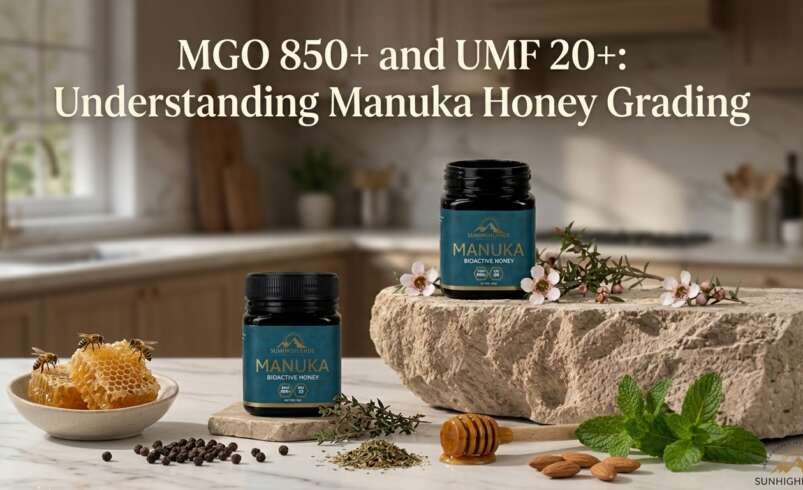

When shopping for premium Manuka honey, Australian consumers often come across labels featuring terms such as MGO 850+ and UMF 20+. At first glance, these numbers can appear to describe the same thing. While they are closely related, they are actually part of different measurement and certification systems.
Understanding the difference between Manuka Honey MGO 850+ and UMF 20+ can make it easier to compare products, interpret labels and understand what you are paying for.
MGO measures the concentration of a specific naturally occurring compound in Manuka honey, while UMF™ is a separate trademarked grading and certification system that assesses several characteristics of New Zealand mānuka honey. The two can be compared approximately by MGO concentration, but an MGO rating should not automatically be considered a UMF certification.
What Is MGO in Manuka Honey?
MGO stands for methylglyoxal. It is a naturally occurring compound associated with the characteristic bioactivity of Manuka honey.
MGO develops from another naturally occurring compound called dihydroxyacetone (DHA), which is found in the nectar of some Leptospermum species. As honey matures, DHA can convert into MGO, contributing to the measurable MGO concentration in the finished honey.
The Australian Manuka Honey Association (AMHA) uses MGO as a central measurement in its Australian Manuka honey quality framework. The association notes that MGO can be directly measured through laboratory analysis, including HPLC testing.
This makes MGO particularly useful for consumers because it provides a numerical measurement rather than a general marketing description such as “active” or “premium.”
What Does MGO 850+ Mean?
When you see MGO 850+ on a Manuka honey jar, the number refers to the concentration of methylglyoxal in the honey, expressed in milligrams per kilogram (mg/kg).
The “850+” designation indicates a high MGO level represented by that rating.
It is important to understand that MGO is a measurement of one particular compound. It is not a medical dosage, and the number should not be interpreted by itself as a guarantee that the honey will produce a particular health outcome.
For Australian Manuka honey, the AMHA uses MGO alongside other criteria to help identify and authenticate Manuka honey produced from Leptospermum nectar.
What Is UMF 20+?
UMF™ stands for Unique Mānuka Factor™. It is a separate grading and certification system operated by the Unique Mānuka Factor Honey Association in New Zealand.
Unlike MGO, which focuses specifically on methylglyoxal concentration, the UMF system uses a four-factor quality assurance approach. The current UMF materials identify:
- MGO for potency
- Leptosperin for authenticity
- DHA for shelf life
- HMF for freshness and quality
The UMF Association’s published grading information places UMF 20+ at approximately 829 mg/kg of MGO, alongside minimum levels for the other factors in its four-factor system.
This explains why an MGO level around 850 mg/kg is sometimes described as being approximately equivalent to UMF 20+.
However, there is an important distinction: being around the MGO threshold associated with UMF 20+ does not mean that a honey is UMF-certified.
MGO 850+ vs UMF 20+: Are They the Same?
No. They are comparable in one respect, but they are not the same grading system.
Think of it this way:
MGO 850+
Measures the concentration of methylglyoxal in the honey.
UMF 20+
Represents a UMF-certified grade based on multiple quality factors, including MGO, Leptosperin, DHA and HMF.
The Sunhighlands product page describes its Australian product as “MGO 850+ (EQV UMF 20+)“.
The word “EQV”, meaning equivalent, is important. It indicates a comparison based primarily on the MGO level rather than saying that the Australian honey carries the UMF certification itself.
This distinction is particularly relevant for Australian consumers because they may encounter MGO-based Australian products alongside UMF-labelled New Zealand products.
Why Is MGO Popular for Australian Manuka Honey?
Australia has a large diversity of Leptospermum species, with the AMHA noting more than 80 native species growing across different Australian environments. Australian Manuka honey can be monofloral or multifloral depending on the floral sources visited by bees.
The AMHA has developed an Australian-focused authenticity framework using MGO, DHA and other identifying characteristics. Its Mark of Authenticity requires qualifying honey to be produced in Australia and independently tested against specified criteria.
For the AMHA “Authentic” mark, products must meet minimum levels of 85 mg/kg MGO and 170 mg/kg DHA when packed, along with requirements relating to the identity and production of the honey.
This means that MGO is especially relevant when discussing the grading of Australian Manuka honey.
How Laboratory Testing Fits Into MGO Grading
A number printed on a label is most useful when it can be supported by laboratory testing.
The AMHA states that its quality approach relies on independent laboratory testing and supply-chain traceability. It notes that member suppliers maintain Certificates of Analysis from independent third-party laboratories for Manuka honey batches.
For consumers, independent testing can help establish that the stated MGO concentration has actually been measured.
The MGO 850+ information similarly states that its honey undergoes laboratory testing for its MGO rating and quality.
When comparing a Manuka honey product, it is therefore useful to look for transparent information about testing rather than relying on the MGO number alone.
Why Does UMF Measure More Than MGO?
One of the most important features of the UMF system is that it does not rely solely on methylglyoxal.
According to the UMF Association, its four-factor test considers potency, authenticity, shelf life and freshness. MGO is used as the potency marker, while Leptosperin, DHA and HMF provide additional information.
For example, the UMF 20+ specifications published by the association list approximately:
| Quality factor | UMF 20+ reference |
|---|---|
| MGO | 829 mg/kg |
| Leptosperin | >200 mg/kg |
| DHA | >500 mg/kg |
| HMF | <40 mg/kg |
These figures come from the UMF Association’s published four-factor quality specifications.
This illustrates why UMF 20+ cannot simply be reduced to “850 MGO”. MGO is one of several factors considered under the UMF system.
Does MGO 850+ Mean the Honey Is UMF Certified?
Not necessarily.
A product can have an MGO concentration around the level associated with UMF 20+ without carrying a UMF certification.
The UMF Association states that the UMF quality mark identifies certified New Zealand mānuka honey that has gone through its certification and verification process. Its materials also describe UMF as a system covering potency, authenticity, shelf life and freshness.
Therefore, consumers should distinguish between:
“MGO 850+” — a stated MGO concentration.
“Equivalent to UMF 20+” — a comparison between MGO concentration and a UMF reference level.
“UMF 20+ certified” — a product carrying the actual UMF certification and complying with the UMF system’s requirements.
These terms should not be used interchangeably.
How Should Australian Consumers Compare MGO and UMF?
When comparing Manuka honey, start by identifying which system the product actually uses.
For an Australian Manuka honey labelled MGO 850+, focus on the MGO measurement, Australian origin and independent testing.
For a product labelled UMF 20+, check that it actually carries the UMF quality mark and relevant certification details.
The product’s country of origin is another important factor. The AMHA specifically provides a framework for authentic Australian Manuka honey produced from Australian Leptospermum sources.
Meanwhile, UMF’s own certification system is designed around New Zealand mānuka honey.
This makes origin particularly important when comparing products that use different grading terminology.
Is a Higher MGO Always Better?
A higher MGO number means a higher measured concentration of MGO, but that does not automatically mean every consumer needs the highest available grade.
MGO should be considered alongside factors such as:
- Country of origin
- Authenticity
- Independent laboratory testing
- Traceability
- Intended use
- Taste preferences
- Price
It is also worth remembering that Manuka honey remains a food naturally containing sugars and carbohydrates. A higher MGO rating does not change that basic nutritional characteristic.
Consumers should also avoid interpreting an MGO rating as a substitute for medical treatment or professional health advice.
Why Is MGO 850+ Commonly Linked With UMF 20+?
The connection comes from the MGO concentration used in the UMF grading framework.
The UMF Association’s published table places UMF 20+ at around 829 mg/kg MGO. Since MGO 850+ is above that reference concentration, some retailers use an “equivalent UMF 20+” comparison when describing a product.
Sunhighlands uses this terminology on its MGO 850+ Australian Manuka honey page.
The important point is that numerical equivalence does not equal certification equivalence.
An MGO 850+ Australian honey can be described in relation to a UMF reference level while remaining a product that is graded and marketed using the MGO system.
What Should You Look for on the Label?
When buying high-grade Manuka honey in Australia, check the label carefully.
Look for a clearly stated MGO rating, country-of-origin information and details about testing or authentication.
For Australian Manuka honey, the AMHA Mark of Authenticity can provide additional assurance because qualifying products must be produced in Australia and independently tested against the association’s criteria.
If a product claims to be UMF 20+, look for the actual UMF quality mark and certification information rather than assuming that an MGO number alone represents UMF certification.
Final Thoughts
Understanding MGO 850+ and UMF 20+ is much easier once you recognise that they belong to different systems.
MGO 850+ refers to a high concentration of methylglyoxal and is a particularly useful measurement for comparing Australian Manuka honey. The AMHA uses MGO as a central part of its Australian Manuka honey rating and authenticity framework.
UMF 20+, on the other hand, is a certified grade within the UMF system, which evaluates MGO alongside Leptosperin, DHA and HMF. The UMF Association places its UMF 20+ MGO reference at approximately 829 mg/kg.
That is why an Australian MGO 850+ product may be described as approximately equivalent to UMF 20+, but consumers should not assume that the two labels represent identical certifications.
When choosing premium Manuka honey, the most useful approach is to look at the MGO level, country of origin, authenticity credentials, independent testing and traceability together.
Understanding the grading language gives Australian consumers a clearer picture of what is inside the jar—and makes it easier to compare Manuka honey products based on meaningful information rather than marketing terminology alone.