
More projects do not automatically create more qualified crews
North America is building data centers, factories, energy facilities, roads and bridges at the same time. Equipment can be ordered and capital can be committed quickly. Developing people who can operate safely, diagnose problems and produce reliable field information takes longer.
The construction labor shortage North America faces is often described as a missing headcount. In specialized drilling, the shortage is more precise. Companies may find entry-level workers but lack experienced operators, field supervisors, mechanics and people ready to lead difficult projects.
US Bureau of Labor Statistics data show that on-the-job training remains central across construction occupations. In geotechnical work, that training includes equipment, geology, sample quality, documentation and site safety. The combination makes crew development slower than filling a general labor position.
The industry depends on knowledge that is rarely written down
Experienced drillers recognize changes in vibration, cuttings, return flow and machine response. They know when refusal may be a boulder rather than bedrock and when a sample is being disturbed by the method.
Many companies have relied on this knowledge passing informally from operator to helper. That approach becomes fragile when senior employees retire or move to supervision. If procedures and lessons remain in one person’s memory, every departure removes productive capacity.
Geotechnical drilling crews need standard work for setup, sampling, depth control, maintenance and reporting. Standardization does not replace judgment. It gives new employees a reliable baseline and makes the exceptions easier to teach.
Training should follow a visible progression
A worker becomes an operator through demonstrated competence, not time served alone. A structured path might move from site setup and sample handling to rod work, daily service, controls, supervised operation and independent leadership.
Drilling rig operator training should include the reason behind each procedure. An employee who understands how poor sample recovery affects the engineer’s conclusion is more likely to stop and ask for direction rather than simply push for footage.
Companies should document who is qualified for each machine, method and task. This helps dispatch choose a complete crew instead of assuming that any available operator can handle sonic drilling, coring, limited access or winter work equally well.
The skilled trades shortage reaches the maintenance shop
Modern rigs combine hydraulics, diesel engines, electronics, sensors and software. A company may have qualified operators but insufficient technicians to keep a growing fleet reliable.
Maintenance training deserves its own career path. Operators should perform inspections and routine service, while technicians handle diagnosis, calibration and major repair. Clear boundaries prevent both neglect and unsafe improvisation.
Parts documentation and remote support can shorten downtime. They work best when the person at the machine understands test points, isolation and basic troubleshooting. Technology does not remove the need for skill; it changes which skills are valuable.
Equipment design affects recruitment and retention
Drilling is physically demanding. Repetitive lifting, awkward hose handling, noise, vibration and weather exposure can push workers out of the trade.
Mechanized rod handling, effective clamps, safe access, good lighting and organized controls can reduce strain. Equipment selection should include operator and mechanic input, not only management comparison of specifications.
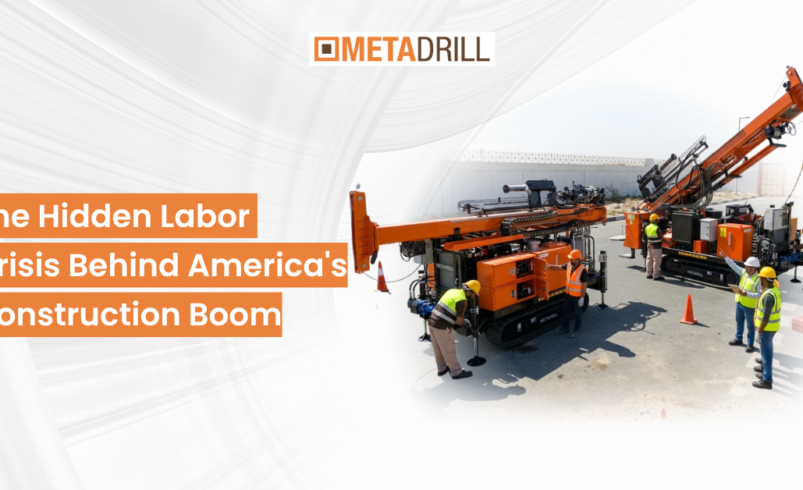
Resources such as MetaDrill North America allow contractors to review rig configurations. During evaluation, ask how the design changes setup time, manual handling, visibility and maintenance access. A machine that reduces daily fatigue can support retention as well as productivity.
Boom schedules can make the shortage worse
When backlog grows, companies often postpone training and maintenance because every crew is needed in production. This creates a cycle: inexperienced employees receive less coaching, machines break more often and senior staff spend their time solving preventable emergencies.
Protected training days and maintenance windows may appear to reduce utilization. Over a season, they create more reliable capacity. A company that schedules no time to develop people will remain dependent on a small group of overextended experts.
Owners contribute to this problem when scopes change late, access is not ready or crews wait for utility clearance. Skilled time lost to preventable coordination is capacity the market cannot easily replace.
Travel and schedule quality influence retention
Field drilling often requires early starts, remote work and uncertain finish times. Some variability is inherent, but poor planning can make the job needlessly disruptive.
Regional scheduling, realistic notice, suitable accommodation and clear rotations help employees plan their lives. Cold-weather clothing, heat controls, clean facilities and safe transport show whether a company treats field work as a profession.
Pay matters, but employees also judge whether the organization sends them to prepared sites with complete tooling and support. Repeated emergency mobilizations can erase the benefit of a higher hourly rate.
Partnerships can widen the entry path
Contractors can work with vocational schools, community colleges, unions and workforce programs to introduce the trade. Geotechnical drilling is not widely understood, so recruitment needs to show the career beyond the helper position.
Apprenticeships and paid work-based learning can combine classroom fundamentals with field experience. Military veterans, heavy-equipment technicians and workers from adjacent trades may bring transferable skills.
Mentors need preparation too. Being an excellent operator does not automatically make someone an effective teacher. Simple coaching guidance and recognition for training work can improve the experience for both people.
Clients should evaluate crew depth not only equipment count
A proposal may list several rigs, but project capacity depends on qualified personnel. Owners should ask who will lead each crew, what backup exists and how field records will be reviewed.
Long programs may benefit from continuity requirements and planned rotation. Specialized methods should have more than one authorized operator where practical. The contractor should also explain how new employees are supervised.
Production metrics need balance. Footage, sample quality, safety, maintenance and documentation all matter. Rewarding speed alone can teach the wrong behavior.
The workforce solution is operational
The labor crisis will not be solved by one recruitment campaign. Contractors need repeatable systems that turn new hires into competent crew members and experienced operators into mentors, supervisors and technical specialists.
That means documenting knowledge, investing in safer equipment, protecting training time and improving schedule quality. Companies that do this will still feel the skilled trades shortage, but they will convert more of their workforce into reliable capacity.
The construction boom is creating demand. The firms that can develop people as deliberately as they purchase machines will be the ones able to deliver it.