

For most of the last two decades, the outdoor kitchen had a predictable centerpiece: the grill. A built-in gas grill, maybe a side burner, a mini fridge, some counter space for prep that was the formula, and it barely changed from one renovation to the next. Walk through a new backyard build today, though, and the layout looks different. The grill is often still there, tucked to one side. But increasingly, the thing everything else is arranged around is a pizza oven.
This isn’t a small aesthetic shift. It’s a change in what homeowners actually want an outdoor kitchen to do, and it says something about how people are using their backyards differently than they were even five years ago.
The Grill-Centric Kitchen Is Losing Its Monopoly
Grills are efficient, familiar, and fast which is exactly why they dominated backyard design for so long. But efficiency was never really the emotional draw of an outdoor kitchen. People weren’t building $20,000 backyard setups because grilling a burger outside is meaningfully better than grilling one on a $200 unit from a hardware store. They were building them because outdoor cooking, done well, becomes an event.
That’s precisely where the grill starts to lose ground to the oven. A grill is something one person tends while everyone else waits. A pizza oven, by contrast, turns cooking into something closer to a shared activity stretching dough, adding toppings, watching the crust blister in real time. It’s a different kind of centerpiece because it invites a different kind of participation.
Why the Oven Became the Anchor Point
Designers who work on outdoor kitchens point to a few converging reasons for the shift. First, pizza ovens have simply become more accessible. What used to require a custom masonry build — a brick dome, a proper flue, a multi-week construction timeline — can now be achieved with a prefabricated unit that gets delivered, installed, and running within a day or two. That alone removed the biggest barrier that used to keep pizza ovens out of ordinary backyard renovations.
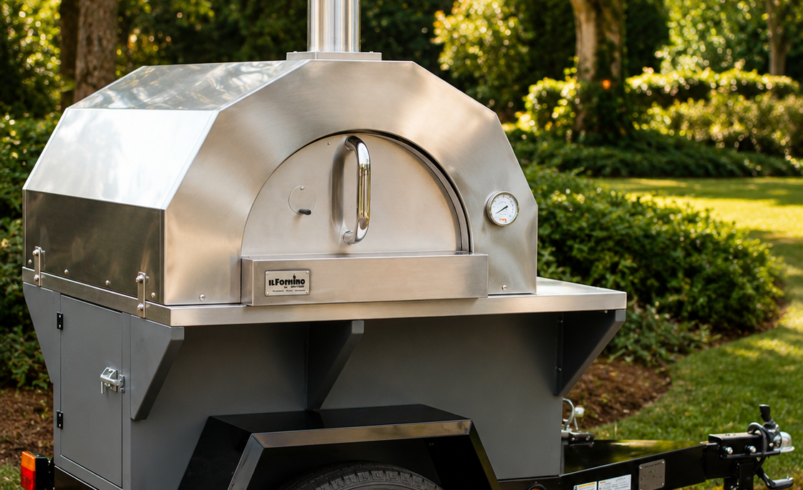
Second, there’s a visual argument. A pizza oven, whether it’s a traditional dome or a modern stainless steel build, reads as a structural feature rather than an appliance. It has presence in a way a built-in grill rarely does. Landscape architects increasingly treat it the way they’d treat a fire pit or an outdoor fireplace: not just functional, but a literal focal point the rest of the layout gets built around — seating arranged in a half-circle facing it, sightlines from the kitchen window angled toward it, lighting designed to highlight it after dark.
Third, and maybe most practically, a pizza oven does something a grill can’t: it turns dinner into a multi-course backyard experience without much extra effort. Flatbreads and appetizers while the main course finishes. Dessert pizzas after everyone assumed the meal was over. The same heat source stretches across an entire evening instead of a single cooking window.
It’s a Social Object, Not Just an Appliance
There’s a reason so many people describe pizza night as an “event” rather than a meal. The process itself — stretching dough, choosing toppings, timing the oven — is participatory in a way that grilling a steak simply isn’t. Guests gravitate toward it. Kids get involved in a way they rarely do with a hot grill they’re told to stay away from. It becomes less about feeding people and more about giving them something to do together.
This social pull is a big part of why pizza ovens have become such a fixture at the exact type of gathering outdoor kitchens are built for — birthday parties, weekend hangouts, holiday get-togethers. The oven doesn’t just produce food faster; it produces a shared activity, which is a fundamentally different value proposition than a grill offers.
The Design Implications Nobody Mentions
Once a pizza oven becomes the anchor of an outdoor kitchen, it changes a surprising amount of the surrounding design. Counter space shifts toward a dough-prep zone rather than a plating station. Storage needs to accommodate pizza peels, cutting boards, and ingredient trays instead of just grilling tools. Some homeowners are even reworking their outdoor seating into more of a “watch the cook” configuration, similar to bar seating around an open kitchen indoors, because the oven itself has become something worth watching.
There’s also a ventilation and clearance consideration that grills never really required in the same way. Wood fired and even some gas ovens produce more radiant heat and, depending on fuel type, need proper clearance from structures and overhangs — which means the oven often ends up dictating where the rest of the kitchen gets built, rather than being squeezed in as an afterthought.
Cost Isn’t the Barrier It Used to Be
A decade ago, a proper wood fired pizza oven meant a custom masonry project running well into five figures, plus a construction timeline measured in weeks. That reputation still lingers, which is part of why some homeowners assume a pizza oven is out of reach for a standard backyard renovation budget.
In reality, prefabricated and modular pizza ovens have compressed both the cost and the timeline dramatically. Entry-level units can slot into a backyard renovation budget alongside — rather than instead of — a grill, which is part of why so many new outdoor kitchens now feature both rather than treating it as an either/or decision. The oven has shifted from “luxury add-on” to “reasonably attainable feature,” and that shift alone explains a lot of its sudden prevalence in renovation plans.
The Rise of the “Cook Together” Backyard
Zoom out, and the pizza oven trend fits into a broader pattern in outdoor living: a move away from solo-cook, spectator-eat setups and toward spaces designed for shared cooking. Outdoor pizza nights, communal dough-stretching, kids picking their own toppings — it’s a format that rewards involvement rather than passive waiting, and that’s increasingly what people want out of a backyard investment.
It also reflects a broader cultural pull toward the kind of slower, ingredient-forward cooking associated with wood fire and open flame — something that’s shown up just as much in restaurant trends over the past several years as it has in residential backyards.
What This Trend Actually Reflects
The shift from grill-centric to oven-centric outdoor kitchens isn’t really about pizza. It’s about what people are asking their backyards to do. A grill answers the question “how do I cook dinner outside.” A pizza oven answers a different question entirely: “how do I get people to want to spend the evening out here.” That’s a more ambitious ask, and it’s exactly why the oven has quietly become the thing everything else gets built around.
Frequently Asked Questions
Do pizza ovens require a permanent, built-in installation?
Not necessarily. While custom masonry ovens are still built into permanent structures, many modern prefabricated units can stand freely on a patio or be integrated into an outdoor kitchen counter, giving homeowners flexibility depending on budget and space.
Are wood fired or gas pizza ovens better for a backyard renovation?
It depends on the priority. Wood fired ovens offer a more traditional flavor and experience but require more attention to fuel and heat management, while gas ovens heat faster and are generally lower-maintenance, making them a common choice for homeowners who want convenience alongside the visual centerpiece effect.
How much clearance does a pizza oven need from the house?
This varies by oven type and fuel source, but most manufacturers specify minimum clearances from structures, overhangs, and combustible materials, so it’s worth checking local building codes and manufacturer guidelines before finalizing a layout.
Can a pizza oven replace a grill entirely in an outdoor kitchen?
For some homeowners, yes — but many outdoor kitchens now include both, since a grill and a pizza oven serve different cooking needs and, together, extend what a single outdoor setup can realistically produce for a gathering.