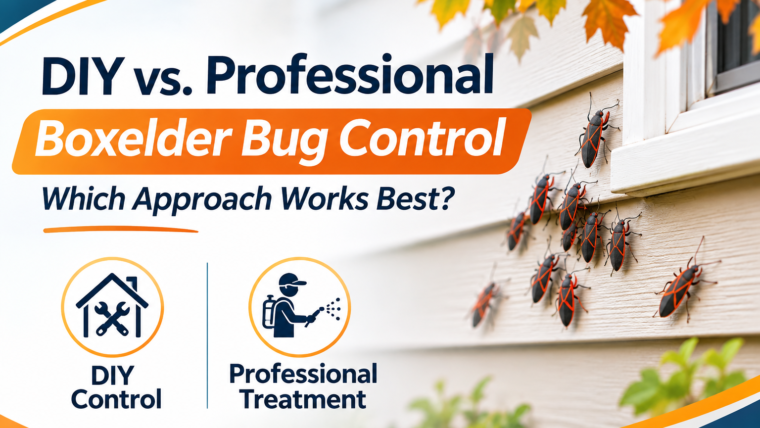

If boxelder bugs are clustering on your siding, sneaking through window gaps, or piling up in corners by the hundreds, you are probably weighing a quick store-bought fix against calling someone in. The honest answer is that DIY pest solutions work reasonably well in some situations and fall short in others, and knowing which situation you are in changes everything. Here is how to read the difference.
What Makes Boxelder Bugs Hard to Control
Boxelder bugs do not nest inside walls the way termites or carpenter ants do, but that does not make them easy. Their numbers are tied directly to the boxelder, silver maple, and ash trees on or near your property. When those trees produce seeds in late summer and fall, the bugs aggregate in large groups to feed, then seek warm overwintering sites, which usually means your house. The population you see on the exterior is often a fraction of what is resting in wall voids, attics, and crawl spaces.
That biology creates the core problem with most DIY approaches: spraying what you can see does not address where the bugs are going. A surface application may knock down the bugs on your foundation today and do very little to the ones already inside the wall cavity or waiting in the tree canopy.
Where DIY Pest Solutions Actually Help
DIY is most effective when the infestation is early, the entry points are visible, and the population is still mostly on the exterior. At that stage, a homeowner can accomplish quite a bit.
Exclusion is the highest-value DIY task. Sealing gaps around window frames, door sweeps, utility penetrations, and soffit vents with caulk or weatherstripping physically stops entry. This is preventive maintenance that pays off year after year, not just during a single season. No insecticide application, professional or otherwise, substitutes for a well-sealed building envelope.
Exterior perimeter sprays with products labeled for boxelder bugs can reduce the number of bugs reaching entry points if applied at the right time. Seasonal treatment timing matters here: late summer through early fall, before the bugs begin moving toward structures, is when exterior sprays are most effective. Applying them in November, after the bugs have already moved inside, produces minimal results.
Removing or reducing harborage also helps. Leaf litter, wood piles, and dense ground cover near the foundation give overwintering bugs shelter just outside your walls. Clearing those areas is straightforward and reduces pressure on the structure.
Where DIY Consistently Falls Short
The failure mode most homeowners hit is treating the symptom rather than the source. An aerosol can applied to a cluster on the south-facing wall will kill those bugs. It will not reach the ones already inside, slow the aggregation from nearby trees, or address the entry points that allowed the infestation to develop. A week later, the cluster is back.
Recurring infestations are also a signal that the problem has a structural or environmental component that surface sprays cannot fix. If the same areas of your home are reinfested each fall despite repeated treatment, something about the building or the surrounding landscape is drawing them in at a rate that exceeds what spot treatments can manage.
Interior infestations are the clearest case for professional boxelder bug treatment. Once bugs are overwintering inside wall voids, an exterior perimeter spray cannot reach them, and disturbing them inside the home by vacuuming or spraying can cause them to disperse deeper into the structure. A professional can conduct an exterior pest inspection to identify the specific entry points and treat them precisely, rather than broadly.
Comparing the Two Approaches Side by Side
| Situation | DIY Approach | Professional Boxelder Bug Treatment |
| Small exterior cluster, early fall | Reasonable; perimeter spray plus exclusion work well | Useful but may not be necessary |
| Large aggregation on multiple walls | Limited; surface treatment cannot match the volume | Targeted pest treatment covers more surface area with appropriate products |
| Bugs appearing inside the home | Ineffective; interior sprays can worsen dispersal | Necessary; interior entry points require professional inspection and treatment |
| Recurring infestations across multiple seasons | Addresses symptoms, not cause | Exterior pest inspection can identify structural and environmental factors driving recurrence |
| Post-season prevention | Exclusion and harborage removal are highly effective DIY tasks | Preventive maintenance agreements can include seasonal treatment timing built into the schedule |
What Professional Boxelder Bug Treatment Actually Changes
The practical difference is access, timing, and diagnosis. A licensed pest management professional will typically start with an exterior pest inspection to find where bugs are entering, where they are aggregating on the structure, and what conditions on the property are contributing to the problem. That inspection shapes the insecticide application, so product is placed where it will intercept bugs rather than where they happen to be visible.
Professional pest management methods also include products and application equipment that are not available over the counter. More importantly, a professional can treat wall voids, attic spaces, and other interior harborage areas without driving bugs deeper into the living space, which is a real risk with amateur interior treatment.
For long-term home protection, professionals can also recommend whether a boxelder or silver maple on the property is the primary driver, and whether any structural changes would reduce recurring pressure. That kind of diagnostic conversation does not happen with a store shelf purchase.
Seasonal Treatment Timing: The Factor Most Homeowners Miss
Boxelder bug control is not a year-round task, but the window for effective treatment is narrower than most people expect. The optimal exterior treatment period runs from when bugs begin aggregating on warm surfaces in late summer through the first few weeks of fall migration toward structures. Once temperatures drop and bugs have moved into wall voids, exterior sprays accomplish very little.
This timing issue is one reason recurring infestations are so common. A homeowner notices the problem in October or November, applies a perimeter spray, and sees limited results. The following fall, the same thing happens. Getting ahead of the aggregation phase, with exclusion work done in summer and exterior treatment applied before the migration begins, consistently outperforms reactive treatment.
If you have missed the window, the focus should shift to sealing entry points so next season’s population cannot enter, and addressing any bugs already inside through careful vacuuming rather than interior sprays.
Making the Call
DIY boxelder bug control is a reasonable starting point when the infestation is exterior, early, and limited in scale. Add exclusion work and correct seasonal treatment timing, and many homeowners can manage the problem adequately on their own. When bugs are already inside, populations are large and recurring, or previous attempts have not produced lasting results, professional boxelder bug treatment is the more efficient path. The inspection step alone often identifies factors that explain why DIY efforts have not held.
For homeowners dealing with a persistent or interior infestation, connecting with a licensed local provider for Reliable Boxelder Bug Removal is a practical next step. A referral service can match you with an independent licensed contractor in your area who can conduct an inspection and recommend a targeted approach based on what is actually happening at your property, not a generic treatment plan.