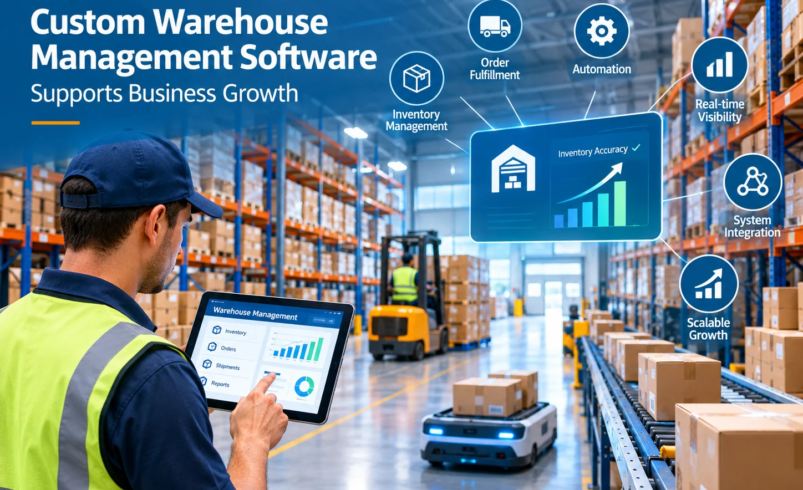

As businesses expand, warehouse operations become more complex. Managing increasing order volumes, maintaining accurate inventory, coordinating warehouse employees, and meeting customer expectations can become challenging when companies rely on manual processes or generic software. These challenges can slow down order fulfillment, increase operational costs, and limit business growth.
Custom Warehouse Management Software helps businesses overcome these challenges by providing tools designed around their specific operational requirements. From real-time inventory tracking to automated order processing, a customized warehouse management system improves efficiency, strengthens inventory control, and supports long-term scalability.
What Is Custom Warehouse Management Software?
Custom Warehouse Management Software is a digital solution designed to manage warehouse activities according to a company’s unique workflows, inventory requirements, and business objectives. Unlike standard software with predefined features, a custom solution allows businesses to choose the functionalities that best support their operations.
A warehouse management system (WMS) can manage receiving, putaway, storage, picking, packing, shipping, stock transfers, and inventory reporting through a centralized platform.
Depending on business requirements, custom software can also integrate with enterprise resource planning (ERP) systems, eCommerce platforms, transportation management systems (TMS), barcode scanners, RFID devices, and other operational tools.
7 Ways Custom Warehouse Management Software Supports Business Growth
1. Improves Inventory Accuracy and Visibility
Inventory accuracy plays a significant role in warehouse performance. When businesses depend on spreadsheets or manual stock updates, they may encounter discrepancies, misplaced products, stockouts, and excess inventory.
Custom warehouse management software provides real-time visibility into stock quantities, storage locations, product movements, and inventory adjustments. Barcode scanning and RFID integration can help employees record stock movements more accurately and reduce manual data entry.
Businesses can use these capabilities to:
- Monitor stock levels across multiple warehouse locations.
- Track batches, serial numbers, and product expiration dates.
- Identify slow-moving and fast-selling products.
- Reduce inventory discrepancies and unnecessary purchases.
- Make informed replenishment decisions.
With better inventory visibility, businesses can respond more effectively to demand changes and maintain the right products in the right locations.
2. Automates Repetitive Warehouse Operations
Manual warehouse activities consume valuable time and increase the possibility of human error. Employees may spend hours updating records, assigning storage locations, preparing picking lists, and processing orders.
A customized WMS can automate repetitive tasks according to established business rules. For example, the system can suggest storage locations, generate picking instructions, prioritize urgent orders, and trigger replenishment alerts when inventory falls below a defined threshold.
Automation helps warehouse teams complete routine activities with fewer unnecessary steps. It also allows managers to allocate employees more effectively and focus on activities that require human judgment.
3. Speeds Up Order Fulfillment
Customers expect accurate orders and timely deliveries. Delays caused by inefficient picking, incorrect packing, or missing inventory information can damage customer relationships and increase return costs.
Custom warehouse management software connects inventory records with order processing workflows. Employees can access picking instructions, confirm product quantities, and update order statuses through a centralized system.
Features such as batch picking, zone picking, barcode verification, and automated packing documentation can further improve fulfillment efficiency.
A well-designed system can also integrate with shipping providers and transportation platforms, helping warehouse teams coordinate dispatch activities more effectively.
4. Reduces Operational Costs
Growing warehouse operations often face increasing labor expenses, storage costs, inventory carrying costs, and order processing expenses. Without reliable operational data, identifying the main sources of inefficiency can be difficult.
Custom warehouse software helps businesses monitor key performance indicators, including order processing time, inventory turnover, picking accuracy, and labor productivity.
Managers can use these insights to identify bottlenecks, improve storage arrangements, reduce unnecessary product movements, and optimize employee workloads.
The software can also support demand forecasting and inventory planning, helping businesses avoid excessive stock accumulation and reduce the risk of product shortages.
Although software development requires an initial investment, businesses can evaluate its long-term value by comparing implementation and maintenance costs with measurable improvements in productivity, accuracy, and operational efficiency.
5. Supports Multi-Warehouse Management
Expanding into new regions or distribution centers introduces additional operational challenges. Businesses must coordinate stock transfers, monitor inventory across locations, and maintain consistent processes between facilities.
A custom warehouse management system can provide centralized inventory visibility across multiple warehouses. Authorized users can view stock availability, review transfers, monitor order fulfillment, and compare performance across locations.
Businesses can also configure location-specific workflows while maintaining consistent reporting standards.
This centralized approach helps management make better decisions about stock allocation and distribution. It can reduce unnecessary transfers, improve order routing, and support expansion into new markets without creating disconnected warehouse operations.
6. Integrates With Existing Business Systems
Warehouse operations depend on accurate information from several business functions. When inventory, sales, purchasing, accounting, and shipping systems operate independently, employees may need to enter the same information multiple times.
Custom Warehouse Management Software can connect these systems through APIs and other integration methods.
Businesses can explore broader logistics software development solutions to understand how connected digital platforms can support warehouse, transportation, and supply chain operations.
7. Provides Scalability for Long-Term Growth
A warehouse system that works well for a small operation may struggle when a business adds more products, users, facilities, or sales channels. Replacing an unsuitable system during expansion can also introduce migration costs and operational disruption.
Custom software can be designed with future growth in mind. Businesses can begin with essential features, such as inventory tracking and order management, and add more capabilities as their requirements evolve.
Potential additions include advanced analytics, AI-assisted demand forecasting, warehouse automation, supplier integrations, and mobile applications for warehouse employees.
Cloud-based architecture can also support access across multiple locations, depending on the system’s design and security requirements.
Scalability allows businesses to improve their warehouse operations progressively rather than rebuilding their entire technology environment whenever their needs change.
Essential Features to Include in a Custom Warehouse Management System
The right features depend on the size of the warehouse, the industry, order volumes, and existing business processes. However, several capabilities are particularly useful for companies planning to scale.
Real-time inventory tracking: Provides visibility into product quantities, storage locations, stock movements, and adjustments.
Barcode and RFID integration: Helps employees identify products, record transactions, and improve stock verification.
Order and fulfillment management: Coordinates picking, packing, verification, and dispatch activities.
Multi-location inventory management: Supports stock visibility and transfers between warehouses or distribution centers.
Reporting and analytics: Tracks operational KPIs and helps managers identify performance issues.
ERP and eCommerce integration: Connects warehouse operations with sales, purchasing, accounting, and other business functions.
Role-based access and security: Helps protect sensitive operational data and restrict access according to employee responsibilities.
Automation and forecasting: Supports replenishment alerts, workflow automation, and demand planning where appropriate.
Businesses should prioritize features that address their current operational challenges instead of adding unnecessary functionality that increases implementation complexity.
Custom Warehouse Management Software vs. Off-the-Shelf Solutions
Both custom and ready-made warehouse systems can improve operational efficiency. The right choice depends on business complexity, budget, implementation timelines, and long-term goals.
Off-the-shelf solutions can be suitable for businesses with relatively standard workflows that need to implement a system quickly. They may offer predefined features and established subscription plans.
Custom solutions are often more suitable when businesses require specialized workflows, industry-specific functionality, complex integrations, or greater control over future enhancements.
A custom system can also be designed around existing operational processes, reducing the need to change workflows solely to fit a standard product.
Before making a decision, businesses should compare the total cost of ownership, implementation requirements, scalability, integration capabilities, vendor support, and data security.
For additional guidance, read this related resource: How to Choose the Right Warehouse Management System.
How to Implement Custom Warehouse Management Software Successfully
Successful implementation begins with a clear understanding of existing warehouse operations and business objectives.
Step 1: Assess Current Warehouse Processes
Identify recurring challenges, such as inventory discrepancies, delayed order processing, inefficient picking routes, and limited reporting. Document the workflows that require improvement.
Step 2: Define Business Requirements
Establish measurable objectives and identify the features needed to achieve them. Requirements may include inventory accuracy, faster order fulfillment, integration with existing platforms, or multi-warehouse visibility.
Step 3: Choose the Right Technology Partner
Select a development partner with experience in software architecture, warehouse workflows, system integrations, and ongoing technical support. Review its development process, security practices, communication methods, and ability to accommodate future changes.
Step 4: Develop and Test the System
Build the solution in manageable phases. Test inventory transactions, order workflows, integrations, access permissions, and reporting before introducing the system into daily operations.
Step 5: Train Employees and Monitor Performance
Provide practical training for warehouse staff and managers. After deployment, monitor relevant KPIs, gather employee feedback, and refine workflows to improve adoption and operational results.
A phased implementation can help reduce disruption while giving businesses time to validate the system before expanding its use.
The Future of Warehouse Management and Business Growth
Warehouse management continues to evolve as businesses adopt cloud platforms, connected devices, data analytics, and intelligent automation.
AI-assisted forecasting can help estimate future inventory requirements, while IoT sensors can monitor selected warehouse conditions and equipment. Robotics and automated material-handling systems can support repetitive physical tasks where the business case justifies their cost.
Custom warehouse management software can provide the integration layer needed to connect these technologies with existing operations.
However, businesses should adopt new capabilities according to their operational priorities, workforce readiness, and expected return on investment. Strong inventory data, reliable workflows, and effective employee training remain essential to achieving meaningful results.
Conclusion
Custom Warehouse Management Software gives businesses greater control over inventory, warehouse workflows, order fulfillment, and operational data. By reducing manual work, improving accuracy, connecting business systems, and supporting multiple locations, it can help organizations build more efficient and scalable operations.
The key is to select a solution that addresses real business challenges while remaining flexible enough to accommodate future requirements. With careful planning, appropriate integrations, and continuous performance monitoring, businesses can turn warehouse management into a strategic advantage.
SSTech System offers technology expertise in warehouse management and logistics software solutions tailored to business requirements. Explore its warehouse management system solutions to learn more about building efficient, connected, and scalable warehouse operations.