

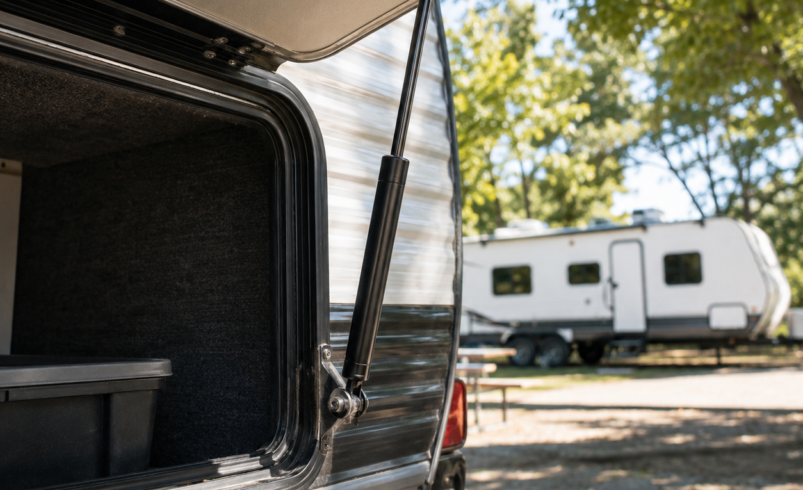

It’s 6:47 PM on a Friday in late September. You’ve just backed into site 14 at a lakeside campground after a four-hour drive, and the light is doing that gold, syrupy thing it only does right before sunset. You crack open a cold drink, walk around to the side of the rig to grab the folding chairs and the cooler from the exterior storage bay — and the door doesn’t stay up. It just… drops. Right onto your knuckles. You yelp, your dog barks, your kid asks if you’re okay, and just like that, the golden-hour magic is gone, replaced by you wedging a broom handle under a hatch door so you can dig out a camp chair. If you’ve RVed for more than a season, you already know exactly what I’m talking about — and you probably know the name for the tiny part that just ruined your evening: the hatch struts (also called gas springs or gas props) that are supposed to hold that door up and didn’t.
This article is about exactly that phenomenon — how the smallest, least glamorous parts of an RV are often the ones that decide whether a trip feels effortless or exhausting. We’ll walk through a realistic camping story, dig into the real, documented problems RVers run into, and talk about what actually helps — grounded in research from RV maintenance data, owner forums, and service records, not just guesswork.
2. A Story: The Weekend Everything Almost Went Wrong
Let’s call them Mark and Dana. Married eleven years, two kids, a golden retriever named Biscuit, and a 2019 travel trailer they’d saved three years to buy. This was supposed to be the “we finally did it” trip — three nights at a state park two hours from home, their first real shakedown cruise as a family of four (plus dog).
The first sign of trouble came at the gas station, twenty minutes from home, when Mark noticed the entry door wasn’t holding itself open in the wind — it kept swinging and banging against the side of the trailer every time a truck rolled past. Annoying, but not trip-ending. He wedged a bungee cord around the handle and kept driving.
The second sign came at the campsite, with the hatch door incident described above. By the third morning, when Dana went to lift the exterior kitchen pass-through hatch to grab the propane stove, it slammed down entirely — the strut had fully given out overnight, likely finished off by two cold nights that stiffened the seal even further.
None of these were catastrophic failures. No one got seriously hurt. But by Sunday, Mark admitted something telling to Dana: “I don’t know if I actually relaxed this whole trip. I kept bracing for the next dumb thing to go wrong.”
That sentence is the whole point of this article. Big RV disasters — blown tires, dead batteries, flooded bathrooms — are rare and dramatic. But research into RV service records shows it’s rarely the big stuff that erodes the joy of camping. It’s the accumulation of small, physical annoyances that quietly determine whether a trip feels like an adventure or a chore.
3. What the Data Actually Shows About RV Problems
It’s tempting to assume the scariest-sounding systems — the fridge, the furnace, the electrical setup — are the biggest headache generators. The data tells a different story. Analysis of RV service and repair records has found that cabinets, entry doors, and storage compartments are the single most common source of RV repair issues, accounting for roughly 7.5% of all service visits — more than exterior body damage, interior wall issues, or slide-out problems individually. These components get opened and closed dozens of times per trip and flex constantly as the rig moves down the road, which is exactly the kind of repeated mechanical stress that wears out small parts fastest.
Digging deeper into why storage compartment doors fail so often reveals a pattern that shows up again and again across RV maintenance forums and repair guides: the gas struts (hatch struts) that hold those heavy doors open are almost always the weak link. These struts work by holding pressurized gas inside a sealed cylinder, and that seal is only a thin rubber component. Because the doors sit closed — meaning the struts sit compressed — for the vast majority of an RV’s life, the seals are under sustained stress even when nobody’s using them. Over time, and sometimes surprisingly quickly, that seal fails, the gas leaks out, and the strut simply stops doing its job. It’s not a question of if it will happen — documented repair guides describe it as basically inevitable, just a matter of when.
Compounding the problem: the mounting brackets that RV manufacturers install for these struts are frequently reported, across multiple owner forums, as under-built for the weight and stress involved — with users describing brackets pulling clean out of particle-board door panels after a few seasons of normal use.
4. Why These “Small” Failures Have an Outsized Impact
Here’s the part that’s easy to underestimate until you’ve lived it: a failing hatch strut isn’t just a mechanical inconvenience — it changes your behavior on the trip.
- It creates a safety hazard. A storage door that won’t stay open can drop suddenly, and RVers repeatedly report smashed fingers and head injuries from doors and struts giving way unexpectedly — enough that RV repair guides specifically flag it as one of the more common minor-injury sources around a campsite.
- It turns routine tasks into two-person jobs. Grabbing firewood, chairs, or the grill becomes something you need a second set of hands for, holding the door while someone else digs through the bay.
- It compounds with weather. Cold weather tends to make gas struts feel weaker (as some RVers have noted, extreme heat can temporarily mask a weak strut, while cold reveals it), meaning the exact camping seasons where you most need reliable, fast gear access — those crisp fall and early spring trips — are when these failures are most likely to show up.
- It quietly shifts your mindset from “relaxed” to “on guard.” This is the least talked-about effect, but arguably the most important. Vacations are supposed to lower your vigilance. A rig that keeps presenting small, unresolved annoyances keeps a low hum of stress running in the background of an otherwise beautiful trip.
5. Beyond Hatches: Other Small Details With Big Impact
Struts and storage doors are a perfect example, but they’re not the only small detail that shapes a trip. A few others worth knowing about, backed by RV maintenance research:
- Latches, not just struts. Compartment door latches — the small pop-out mechanisms that keep doors shut while driving — are prone to breaking, especially in cold weather or after being slammed shut repeatedly. A failed latch isn’t just annoying; a compartment door flying open at highway speed is a genuine road hazard.
- Sealant and seams. Water intrusion around roof seams, windows, and compartment seals is consistently flagged as one of the most expensive categories of RV damage specifically because it’s invisible at first — by the time you see staining or soft flooring, moisture may have already been working on the insulation and subfloor for months.
- Hinges left dry. Simple lubrication — of door hinges, slide-out seals, and storage compartment hardware — is repeatedly cited as one of the cheapest, easiest ways to prevent a large percentage of these “small” failures before they start.
- Owner habits matter more than people expect. Maintenance data suggests roughly a quarter of all “problems” RV techs are called to fix aren’t actual defects at all — they’re solved just by showing the owner the correct way to operate a system. That’s a striking number: a meaningful chunk of camping frustration isn’t bad luck or bad manufacturing, it’s simply not knowing your rig’s quirks yet.
6. What Actually Helps (Prevention and Fixes)
The good news, backed by the same repair data: almost all of this is preventable or fixable without a service center visit.
- Inspect struts before every big trip, not after something breaks. If a hatch or storage door isn’t holding itself fully open anymore, or drops slowly instead of staying rigid, that’s the early warning sign — replace it before it fails completely and drops on your hand or your gear.
- Match strut strength to the door. A common rule of thumb from experienced RV owners: a strut should generally be sized to roughly half the height of the door it’s supporting, plus a bit more, and matched to the door’s actual weight — an underpowered strut will fail faster and won’t hold the door safely.
- Upgrade the mounting hardware, not just the strut. Since weak factory brackets are one of the most frequently cited failure points, replacing both the strut and the bracket at the same time — rather than just swapping the strut — tends to solve the problem for good instead of temporarily.
- Keep hinges and latches lubricated, and tighten hardware screws after long, bumpy drives — a five-minute habit that owner data suggests meaningfully extends the life of doors and compartments.
- Don’t slam it. It sounds almost too simple, but repeated hard slamming of compartment and cabinet doors is specifically called out as a major contributor to premature latch and hinge failure.
- Do a “small parts” walkaround before every trip — hinges, latches, struts, seals — the same way you’d check tire pressure. It takes five minutes and it’s the difference between a relaxed Friday evening at the campsite and a bruised hand.
7. Bringing It Back to the Story
Back to Mark and Dana. On their next trip — after replacing the failed struts and brackets on both the entry door and the kitchen hatch, and adding a quick five-minute hinge check to their pre-trip routine — the difference wasn’t dramatic or Instagram-worthy. Nothing about the campsite looked any different. But when Dana went to grab the stove out of that same hatch on a chilly Saturday morning, the door lifted, held steady, and stayed there while she worked. She didn’t think about it. She didn’t have to.
That’s really the whole story of RV camping’s “small details.” The goal was never to notice them — it was to stop noticing them, so you can actually be present for the sunset, the lake, the kids running around with the dog, instead of bracing for what’s about to fall on your hand next.
8. Key Takeaways
- The most common source of RV repairs isn’t the big, scary systems — it’s everyday cabinets, doors, and storage compartments, largely due to constant flexing and use.
- Hatch struts (gas springs) fail gradually and, per repair guides, essentially inevitably over time, because their internal seals are under stress even when the door is closed.
- Weak factory mounting brackets are a widely reported companion failure — replacing the strut alone often isn’t a permanent fix.
- These small failures matter disproportionately because they create safety hazards, turn simple tasks into two-person jobs, and quietly raise your stress level throughout a trip.
- A short, regular pre-trip inspection of hinges, latches, seals, and struts prevents a large share of these issues before they ever interrupt a camping weekend.